
Every home mechanic needs reliable equipment to work safely and efficiently on vehicles. A quality floor jack stands as one of the most essential pieces of equipment you can own. Whether you’re changing oil, rotating tires, or tackling more complex repairs, having the right jack makes all the difference between a smooth job and a frustrating experience.
Choosing the right floor jack involves more than just picking the cheapest option at your local store. You need to consider your specific vehicles, the type of work you’ll be doing, and the physical constraints of your workspace. This guide will walk you through everything you need to know to make an informed decision that serves you well for years to come.
Understanding Floor Jack Basics
Floor jacks work by using hydraulic pressure to lift vehicles off the ground. Unlike the simple scissor jacks that come with most cars, floor jacks offer greater stability, higher weight capacity, and easier operation. They consist of a horizontal base with wheels, a lifting arm, and a hydraulic pump mechanism operated by a handle.
The lifting mechanism relies on fluid pressure to raise the saddle, which is the part that makes contact with your vehicle. When you pump the handle, hydraulic fluid moves into a cylinder, creating pressure that extends a piston and raises the lifting arm. This system allows you to lift heavy vehicles with relatively little physical effort.
Different designs serve different purposes. Standard jacks work well for most passenger vehicles, while specialized versions handle specific needs. Understanding these differences helps you choose the right tool for your situation.
Weight Capacity Considerations
The weight capacity of your floor jack must exceed your vehicle’s weight. However, don’t just consider the total vehicle weight. You’ll typically be lifting one end of the car at a time, so you need to think about the weight distribution.
Most passenger cars and small SUVs weigh between 3,000 and 4,500 pounds. A jack with a 2-ton capacity (4,000 pounds) handles most standard vehicles comfortably. For larger SUVs, trucks, or if you work on multiple vehicles, a 3-ton jack provides more versatility and a better safety margin.
Additionally, having extra capacity means your jack won’t struggle at its maximum limit. This reduces wear on the hydraulic system and ensures smoother, more reliable operation over time. Think of capacity as an investment in both safety and longevity.
Never exceed the rated capacity of your jack. Doing so risks catastrophic failure that could result in serious injury or death. Always check your vehicle’s curb weight in the owner’s manual and choose a jack with capacity well above half that weight.
The Importance of Lift Height Range
Lift height specifications include two critical measurements: minimum height and maximum height. The minimum height determines how low the jack can go before starting to lift, while the maximum height indicates how high it can raise your vehicle.
Minimum height becomes crucial if you work on sports cars, lowered vehicles, or any car with limited ground clearance. A low profile jack typically starts at around 3 to 4 inches, allowing it to slide under vehicles that sit close to the ground. Standard jacks usually have a minimum height of 5 to 6 inches, which won’t fit under many performance or modified vehicles.
Maximum lift height determines how high you can raise your vehicle. Most jacks lift between 16 and 20 inches. Higher lifts provide more working room underneath your vehicle, making jobs more comfortable and accessible. However, remember that you’ll still need jack stands for safety, which may reduce your actual working height.
Consider both measurements based on your current vehicle and any future vehicles you might own. If you work on a variety of cars, choosing a jack with a lower minimum height gives you more versatility without sacrificing much in other areas.
Construction Quality and Materials
The materials and build quality of your floor jack directly affect its durability and safety. Heavy-duty steel construction provides the best longevity, though it makes the jack heavier and less portable.
Aluminum jacks offer an excellent compromise between strength and weight. They’re significantly lighter than steel, making them easier to move around your garage. However, they typically cost more and may not have the same weight capacity as comparably sized steel jacks.
Look for jacks with reinforced lift arms and welded construction rather than bolted assemblies. Welds create stronger, more durable connections that won’t loosen over time. The saddle should be large and stable, with a rubber pad to protect your vehicle’s frame or jacking points.
Quality hydraulic components make a noticeable difference in performance. Cheap jacks often have seals that leak or pumps that require excessive strokes to lift. Premium jacks use better seals and more efficient pumps, raising vehicles quickly with fewer pumps of the handle.
Mobility and Storage Features
A floor jack’s mobility affects how easily you can position it and move it around your workspace. Larger rear wheels roll more smoothly across garage floors, while front swivel casters allow precise positioning under your vehicle.
The handle length and design impact both leverage and storage. Longer handles provide better leverage, making pumping easier. However, they take up more space when stored. Some jacks feature removable or folding handles that make storage more convenient.
Weight becomes a consideration if you plan to move your jack frequently or store it on a shelf. A 2-ton steel jack might weigh 60 to 80 pounds, while an aluminum version of similar capacity could weigh 30 to 40 pounds. This difference matters significantly when lifting and moving the jack regularly.
Built-in carrying handles make transportation easier. Look for jacks with handles positioned to provide good balance when lifting. Some models include additional features like integrated tool trays or magnetic parts holders that add convenience during use.
Safety Features You Should Demand
Safety bypass systems prevent over-pumping, which could damage the jack or create dangerous situations. This feature automatically stops the jack from lifting beyond its maximum height, protecting both the jack and your vehicle.
Dual-pump mechanisms allow quick lifting with the first stage and fine positioning control with the second. This gives you precision when positioning jack stands or working in tight spaces. The ability to make small adjustments prevents the frustration of over-lifting and having to lower and restart.
A safety valve controls the descent rate, preventing sudden drops that could damage your vehicle or injure you. Quality jacks feature twist-knob release valves that give you precise control over lowering speed. Avoid jacks with simple push-lever releases, as they offer less control.
Rubber saddle pads protect your vehicle’s frame and provide better grip on jacking points. Some jacks include adapters that fit specific jacking points on different vehicle types, further enhancing safety and preventing damage.
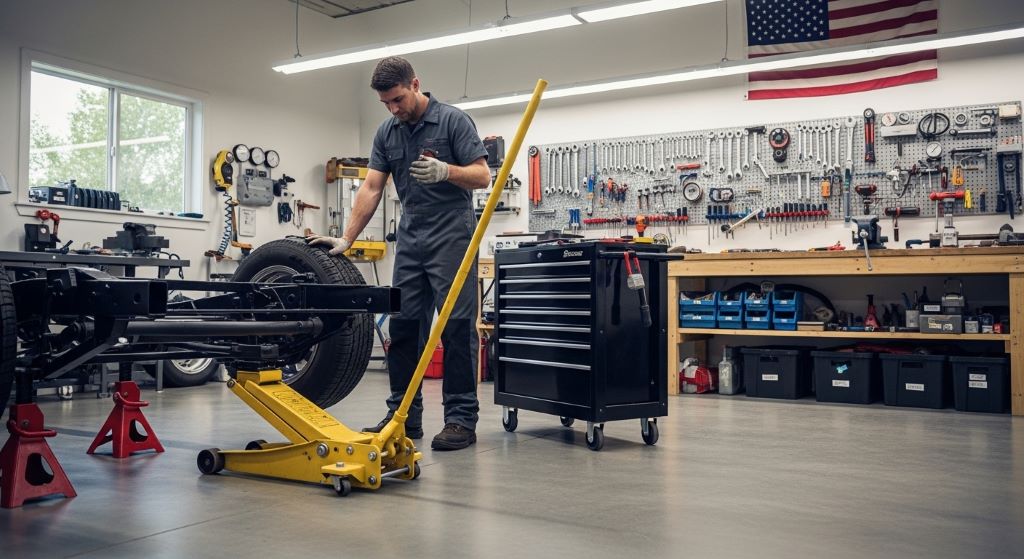
Evaluating Your Garage Setup Tools
Your floor jack doesn’t work in isolation. It’s part of a complete system of garage setup tools that work together to create a safe and efficient workspace. Consider how your jack fits into your overall tool collection.
Jack stands are mandatory safety equipment. Never work under a vehicle supported only by a floor jack. Hydraulic systems can fail, and jacks can slip. Always use jack stands rated for your vehicle’s weight and position them on solid jacking points.
A creeper makes working under your vehicle much more comfortable. Once your car is safely supported on jack stands, you can slide underneath on a creeper to access components. Choose one with adequate padding and smooth-rolling casters.
Wheel chocks prevent your vehicle from rolling while you work. Even with the parking brake engaged, always chock the wheels that remain on the ground. This simple precaution prevents accidents caused by vehicle movement.
A good impact wrench or breaker bar helps remove lug nuts before lifting. Trying to remove tight lug nuts while a vehicle is jacked up is dangerous and ineffective. Remove the nuts while the tire is on the ground, then lift the vehicle to finish the job.
Price Ranges and Value Assessment
Floor jacks range from under one hundred dollars to several hundred, depending on capacity, features, and construction quality. Understanding what you get at different price points helps you make a smart investment.
Budget jacks under seventy-five dollars often work adequately for occasional use. However, they typically feature lower-quality hydraulic systems, basic construction, and minimal safety features. They may require more pumps to lift and can develop leaks more quickly than premium options.
Mid-range jacks between one hundred and two hundred dollars offer the best value for most home mechanics. They provide reliable performance, decent construction quality, and useful features like safety bypasses and better mobility. This range typically includes both quality steel and entry-level aluminum options.
Premium jacks above two hundred dollars deliver professional-grade performance and durability. They feature superior hydraulic systems, lightweight aluminum construction, racing-style low profile designs, and extensive safety features. These jacks excel if you work on vehicles regularly or need specific features for specialized applications.
Consider your usage frequency and the value of your time. A jack that lifts quickly and works reliably saves time on every job. If you perform maintenance monthly, the efficiency gains from a quality jack add up significantly over years of use.
Special Considerations for Different Vehicle Types
Sports cars and modified vehicles often require a low profile jack that can fit under their limited ground clearance. These jacks typically have a minimum height of 3 to 3.5 inches, allowing access when standard jacks won’t fit.
Trucks and SUVs benefit from jacks with higher lift ranges and greater weight capacity. A 3-ton jack with a maximum height of 20 inches or more provides the capacity and reach needed for these larger vehicles. Additionally, the longer lift range gives you better access to undercarriage components.
Classic cars may require extra care due to their age and value. Choose a jack with a wide, padded saddle and consider using a saddle adapter that fits your car’s specific jacking points. The gentler contact reduces the risk of damage to potentially fragile or rusted frame sections.
If you work on multiple vehicle types, versatility becomes paramount. A 3-ton low profile jack with a good lift range handles everything from sports cars to SUVs, though it will cost more and weigh more than a standard 2-ton model.
Making Your Final Decision
Once you’ve considered all these factors, narrow down your choices to two or three models that meet your requirements. Read reviews from other home mechanics who have used these jacks over time. Pay particular attention to comments about reliability, ease of use, and any issues that developed after extended use.
Check the warranty coverage. Quality manufacturers stand behind their products with warranties of one year or longer. A good warranty indicates the company’s confidence in their product and provides protection for your investment.
Consider buying from retailers with good return policies. Even after careful research, you won’t know how well a jack works in your specific situation until you use it. A flexible return policy gives you peace of mind if the jack doesn’t meet your expectations.
Think long-term rather than focusing solely on immediate savings. A quality jack that lasts ten years costs less per year than cheap jacks you replace every two years. Factor in the value of your time, the safety benefits, and the reduced frustration when calculating true value.
Conclusion
Choosing the best floor jack for your home garage requires balancing multiple factors including weight capacity, lift height range, construction quality, and price. A low profile jack serves well if you work on lowered vehicles or sports cars, while standard jacks handle most passenger vehicles adequately. Consider your complete set of garage setup tools to ensure everything works together efficiently and safely.
Remember that your floor jack is a critical safety tool, not just a convenience. Investing in quality equipment protects both you and your vehicles. Take time to assess your specific needs, research your options thoroughly, and choose a jack that provides the features and reliability you require. With the right floor jack and proper safety practices, you’ll handle vehicle maintenance and repairs confidently for years to come.
Frequently Asked Questions
What is the difference between a low profile jack and a standard floor jack?
A low profile jack has a lower minimum height, typically 3 to 4 inches, allowing it to fit under vehicles with limited ground clearance like sports cars and lowered vehicles. Standard floor jacks have minimum heights of 5 to 6 inches and work well for most passenger cars and SUVs. The choice depends on the lowest vehicle you plan to work on in your garage.
How much should I spend on a good floor jack for home use?
For occasional home use, a quality jack in the one hundred to two hundred dollar range provides reliable performance and adequate safety features. If you work on vehicles frequently or need specialized features, investing two hundred to four hundred dollars gets you professional-grade quality. Avoid extremely cheap jacks under fifty dollars as they often lack important safety features and durability.
Can I use a 2-ton jack on a vehicle that weighs more than 4,000 pounds?
A 2-ton jack can safely lift one end of a vehicle weighing more than 4,000 pounds because you’re not lifting the entire weight at once. However, it’s safer to have extra capacity. For vehicles over 4,500 pounds, consider a 3-ton jack for better safety margins and easier operation. Always check your vehicle’s curb weight and ensure your jack’s capacity exceeds half that amount.
Do I really need jack stands if I have a good floor jack?
Yes, jack stands are absolutely essential. Never work under a vehicle supported only by a floor jack, regardless of quality. Hydraulic systems can fail, seals can leak, and jacks can slip. Jack stands provide a mechanical backup that prevents catastrophic accidents. Position them on solid jacking points before getting under your vehicle.
How do I maintain my floor jack to keep it working properly?
Keep your floor jack clean and check the hydraulic fluid level annually. Wipe down the piston and handle after each use to prevent dirt from entering the hydraulic system. Store the jack with the saddle in the lowered position to reduce pressure on the seals. Occasionally, add a drop of oil to pivot points and moving parts. If you notice slow lifting or difficulty pumping, the hydraulic system may need bleeding or fluid replacement.
Related Topics:
Unmasking the Silent Thief: Detect and Fix an Electrical Drain in Your Car
Why is It Bad to Not Put Premium Fuel in a Luxury Car?