You lock your bike outside a Manhattan coffee shop for five minutes. When you come back, the front wheel is gone—but the frame is still there, which tells you the thief knew exactly what they were doing. In New York City, that scenario plays out thousands of times a year, and most of it is preventable. The difference between a bike that survives the city and one that disappears usually comes down to a few specific habits: where you park, what you lock to, and how you position your lock. If you are choosing equipment to go with those habits, this Sportneer bicycle lock guide covers lock options suited to NYC conditions. Below is what actually works when you park on these streets.
Quick Answer
To secure a bike in NYC, lock the frame and at least one wheel to a fixed, immovable object using a high-quality U-lock, and remove anything quick-release. Park in high-visibility areas, vary your routine, and never leave your bike overnight on the street unless you accept the risk. Use two locks if you leave it for extended periods, and always take the saddle and accessories with you when possible.
Key Takeaways
- Lock the frame and wheels—thieves target whichever part is easiest to strip, not just the whole bike.
- Choose your anchor carefully: parking signs, scaffolding, and loose railings are common weak points.
- Position matters as much as lock strength. A strong lock placed badly can be defeated in seconds.
- Time and location drive risk more than the lock alone—an expensive lock in a bad spot still loses.
- Registration, photos, and serial numbers are your only realistic recovery tools if a theft happens.
Why NYC Bike Theft Is Different
New York City combines three factors that make bike theft unusually common: high density, easy resale, and a lot of pedestrian traffic that gives thieves cover. A crowded sidewalk is not a deterrent—it is camouflage. Someone crouched over a bike for thirty seconds looks unremarkable on a busy block.
What makes this manageable is that most thefts are crimes of opportunity. A thief passing by sees an easy target and takes it. Remove the “easy” and you often remove the theft entirely. That is the entire logic behind good parking practice: you are not trying to make your bike impossible to steal, you are trying to make it harder than the bike parked next to it.
What Thieves Actually Target
Whole-bike theft gets the attention, but component theft is far more common and often more expensive to fix. Quick-release wheels, saddles with quick-release clamps, lights, and even pedals disappear constantly because they require no tools and take seconds. If your bike has any quick-release hardware, assume it is a target.
Choosing the Right Anchor Point
The best lock in the world fails if you attach it to something a thief can defeat. In NYC, you will mostly lock to street furniture, and not all of it is equal.
Good Anchor Points
- Permanent, heavy-duty bike racks bolted into concrete
- Steel posts set in the ground that do not wobble
- Solid, thick poles that cannot be lifted over
Anchors to Avoid
- Parking sign poles: Many are designed to be removable, and some can be lifted or unscrewed.
- Scaffolding: Common in NYC, but the pipes are sometimes loose or easily disassembled.
- Thin trees and saplings: Trivially cut, and illegal to lock to in many cases.
- Handrails and loose railings: If it moves when you shake it, it will move for a thief.
- Private property and building fences: Some buildings cut locks without warning.
A quick test: grab the anchor and shake it. If there is any movement, look elsewhere. If you can lift a lock over the top of the anchor, a thief can too.
How to Position Your Lock Correctly
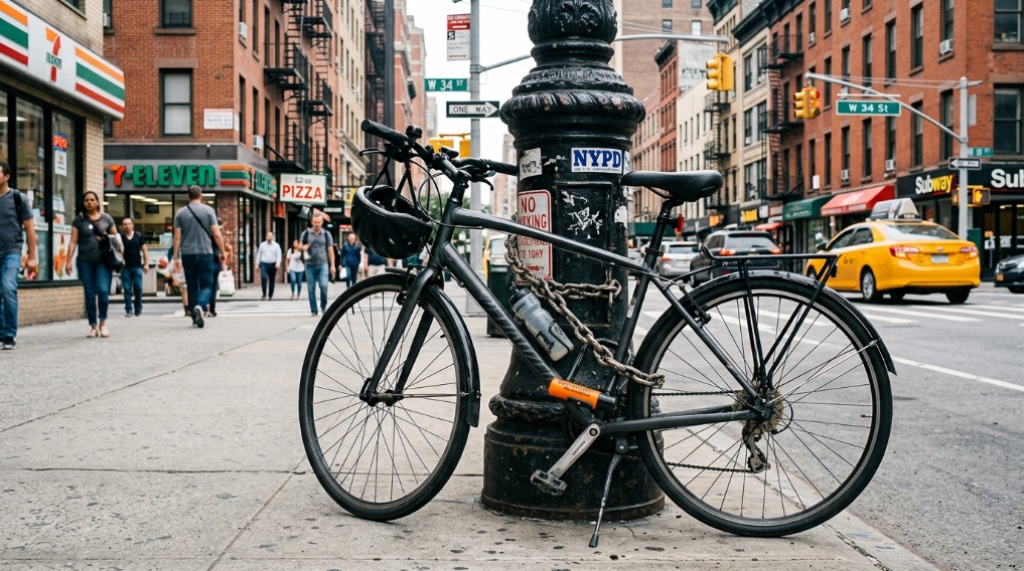
Lock placement is where most people lose their bikes despite owning good equipment. The goal is to fill the lock’s internal space so completely that a thief cannot fit a jack or lever inside. A U-lock that is mostly empty air is far easier to attack than one packed tight.
The Correct Locking Method
- Pass the U-lock through the rear wheel, the frame’s rear triangle, and the anchor point. This single setup secures your most expensive components at once.
- Push the lock as close to the frame as possible so there is no room for a jack.
- Use a secondary cable or chain to secure the front wheel to the frame or the U-lock, since it is not covered.
- Remove your saddle, lights, and any quick-release accessories if you cannot lock them.
Positioning Mistakes That Get Bikes Stolen
- Locking only the frame: Your wheels vanish in under a minute.
- Locking only a wheel: The frame and everything attached to it walks away, leaving one wheel on the rack.
- Locking to the frame’s top tube only near the anchor: Leaves the lock loose and jackable.
- Leaving the lock resting on the ground: A hard surface gives a thief leverage to hammer or twist.
- Locking high on a pole: Raises the bike and invites prying from below.
Choosing and Using a Lock in NYC
Lock type matters, but the brand matters less than the category and how you use it. For NYC, a solid U-lock is the baseline. Chain locks offer more flexibility around awkward anchors but are heavy. Folding locks balance portability and security. Cable locks alone are not enough in this city—they are a supplement, not a primary lock.
| Lock Type | Best Use | Main Weakness |
|---|---|---|
| U-lock | Primary lock for short-to-medium stops | Limited anchor flexibility |
| Chain lock | Versatile anchors, longer stops | Heavy, bulky to carry |
| Folding lock | Balance of portability and security | Some joints are attack points |
| Cable lock | Secondary lock for wheels or accessories | Easily cut with hand tools |
Whatever you carry, the same rule applies: fill the lock, keep it off the ground, and pair it with a secondary lock for components. If you are deciding on a specific model, weight and mounting matter more in NYC than in most cities, because you will carry it more often and lock up more frequently, If you want to transition your indoor training workouts into your content, check out our guide on how to choose the best bike trainer stand for indoor cycling.
Where and When to Park in NYC
Location and timing affect your risk more than any single piece of gear. The same lock in the wrong place fails.
Higher-Risk Situations
- Overnight street parking, especially near transit hubs and college campuses
- Unattended all-day parking in tourist-heavy areas
- Quiet side streets with low foot traffic and no lighting
- Repeated parking in the exact same spot at the same time
Lower-Risk Habits
- Park near building entrances or active storefronts where people are present
- Vary your parking spots and times so your bike is not a predictable target
- Use indoor bike rooms, garages, or office racks when available
- Bring the bike inside your home or workplace whenever you can
If you must park overnight outside, double up on locks and accept that you are taking a real risk. There is no fully theft-proof street parking method in this city—only risk reduction.
Practical Habits That Prevent Theft
Beyond the lock itself, a few routines make a meaningful difference:
- Record your serial number and take clear photos of the bike. This is essential for any police report or insurance claim.
- Register your bike with a national registry and check whether your renter’s or homeowner’s insurance covers it.
- Remove quick-release parts whenever you leave the bike, or replace quick-release skewers with locking ones.
- Do not rely on a single lock for long stops—two different lock types force a thief to carry two different tools.
- Trust your instincts about a location. If a spot feels exposed or sketchy, move.
Frequently Asked Questions
Is it legal to lock a bike to a parking sign in NYC?
Parking sign poles are generally poor anchors because many are removable, and some are technically property that should not be used for locking. Even where it is not strictly prohibited, the risk of the pole being pulled or unscrewed makes it a bad choice.
What is the minimum I need to secure a bike in NYC?
At minimum, a quality U-lock securing the frame and rear wheel to a solid anchor, plus removal of quick-release accessories. A secondary cable for the front wheel improves security noticeably.
Can a bike be stolen even with a U-lock?
Yes. Angle grinders defeat most locks quickly, and poor positioning makes even strong locks easy to attack. U-locks reduce risk significantly but do not eliminate it, especially for overnight or all-day parking.
How long is it safe to leave a bike locked outside in NYC?
There is no guaranteed safe duration. Short stops in visible, busy areas carry lower risk; overnight parking on the street carries high risk regardless of lock quality. Longer unattended periods should prompt stronger locking or indoor storage.
Should I use two locks?
For extended parking or high-theft areas, yes. Two different lock types require a thief to carry multiple tools, and a second lock covers the wheel or frame your primary lock misses.
What should I do if my bike is stolen?
File a police report with your serial number and photos, check local resale platforms and pawn shops, and notify your insurance if covered. Recovery rates are low, which is why prevention and registration matter so much.
Conclusion
Securing a bike in NYC comes down to a short list of habits rather than any single product. Lock the frame and wheels to a solid anchor, position the lock tightly, park in visible and varied locations, and use two locks when you leave the bike for long. No method is theft-proof on these streets, but these practices consistently reduce risk. Treat the lock as one part of a routine—anchor choice, placement, and timing do the rest.