You just bought a sleek new helmet online, excited to hit the pavement. You strap it on, and… it wobbles. It pinches your temples. It sits so high on your head that you look like a mushroom. You are not alone. The single biggest mistake riders make is prioritizing style over safety, which starts with a proper fit. A loose helmet can shift during a crash, leaving your skull exposed. A tight one can cause headaches and distractions.
This is where a solid helmet fit guide becomes your most important tool. We are going to fix this problem today by teaching you exactly how to measure, adjust, and test a helmet so it feels like a natural extension of your head.
What Does a Perfectly Fitting Helmet Actually Feel Like?
A perfectly fitting helmet feels like a firm, gentle hug around your entire head. It should not produce any pressure points, but it also should not slide around when you shake your head. You should feel the foam pads contacting your cheeks and the crown of your head evenly. When you fasten the chin strap, you should be able to open your mouth wide and feel the helmet pull down slightly. That is the sweet spot.
Many riders think a “snug” fit means painful. True. But a good fit is snug without discomfort. The helmet should sit level on your head, with the front edge about one to two finger-widths above your eyebrows. If the brim is higher than that, it is a bucket. If it covers your eyebrows, it is blocking your vision.
The Two-Finger Rule
Place two fingers horizontally between your eyebrows and the bottom edge of the helmet. If you cannot fit two fingers, the helmet is too low. If you can fit three or more, it is too high.
How Do You Measure Your Head for a Helmet?
Measuring your head is the single most important step you can take before buying any helmet. To do it correctly, you will need a flexible measuring tape. Wrap it around your head, about one inch above your eyebrows, covering the widest part of your skull just above your ears. This is your head circumference. Write that number down in centimeters or inches. Most helmet brands use a size chart based on that measurement. Small is typically 20-21.75 inches, Medium is 21.75-23.25, and Large is 23.25-24.75 inches.
If you do not have a tape measure, use a piece of string. Mark the overlap with a pen, then lay the string flat against a ruler. Do not guess your size based on hat sizes or age. Head shapes vary wildly, and a medium from one brand might fit like a small from another.
Measuring for Kids
For children, measure the same way, but remember that kids’ heads grow quickly. A helmet should be snug now, not “room to grow.” Buying a size too large for a child is dangerous because it will not protect them properly in a fall.
Which Helmet Shape Is Right for Your Head?
Your head is not a perfect sphere, and neither is a helmet. The shape of the helmet interior must match the shape of your skull. There are three main head shapes to consider. Round oval heads are nearly as wide as they are long. Intermediate oval heads are slightly longer than they are wide. Long oval heads are significantly longer, with a narrow width. Most helmets on the market are designed for intermediate oval heads. If you have a round head, you might need a brand that offers a round oval fit, or you will get pressure points at the temples. If you have a long oval head, you will feel pressure at the forehead and the back of the skull.
To find your shape, look at yourself from above in a mirror, or ask a friend to trace your head shape on a piece of paper. If you can, try helmets from several brands. Some brands like Giro and Bell tend to favor intermediate oval, while others like Kask lean round. Do not force a shape that does not match.
Why Does Helmet Position Matter So Much?
Helmet position matters because the foam inside is engineered to absorb impact in specific zones. If you wear it tilted back, the front of your forehead is exposed. If you wear it tilted forward, your vision is blocked. The correct position is level. The front edge of the helmet should sit low on your forehead, just above your eyebrows. The back of the helmet should cup the base of your skull. When you look straight ahead, the brim should be parallel to the ground. If it feels like you are looking up at the sky, it is too high. If it feels like you are peeking over a ledge, it is too low.
One easy test is the “eye test.” Look straight ahead. The bottom edge of the helmet should be in your peripheral vision at the very top. If it is not, adjust the fit.
How Do You Use the Retention System Correctly?
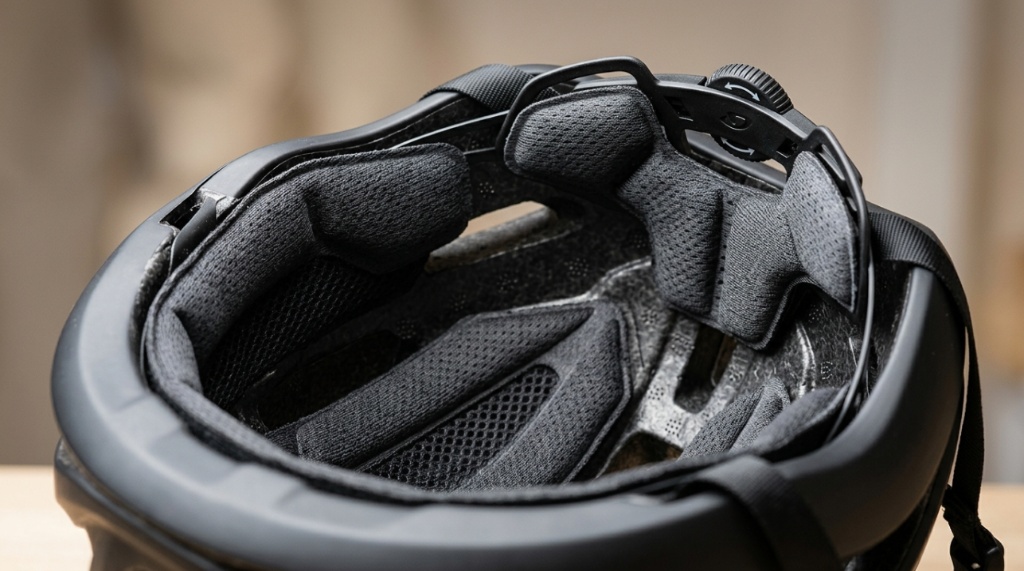
The retention system is the mechanism at the back of the helmet that tightens around your head. Most modern helmets use a dial system. To use it correctly, put the helmet on your head first. Then, while holding the front of the helmet steady, turn the dial clockwise until you feel the cradle grip the back of your skull. It should be firm but not painful. You should be able to shake your head vigorously without the helmet moving more than an inch. If you can spin the helmet around your head, it is too loose. If you feel a headache coming on after two minutes, it is too tight.
Once the dial is set, check the vertical adjustment straps. Those are the plastic Y-shaped pieces that go around your ears. The junction of the Y should sit just below your earlobe. Tighten or loosen the webbing until the helmet sits level. If the Y sits too far forward or backward, the helmet will tilt.
Can You Wear a Beanie or Hat Under a Helmet?
Yes, you can wear a thin beanie or skull cap under a helmet, but it changes the fit. The rule is simple: if you plan to wear a hat, you must fit the helmet while wearing that hat. Do not fit the helmet on a bare head and then add a thick wool beanie later. That will break the fit and likely push the helmet too high. Stick to thin, seamless beanies or caps made of merino wool or synthetic material. Avoid hoodies with bulky hoods, as they lift the helmet off your head. If you ride in winter, consider a helmet that is designed for cold weather or has removable ear pads.
How Should a Helmet Fit for Different Activities?
Different activities require slightly different fit characteristics. For skateboarding, the helmet should sit lower on the back of the head and have a hard outer shell. The fit is typically more round. For cycling, the helmet is usually positioned higher on the forehead, and the fit prioritizes ventilation. For skiing or snowboarding, the helmet must accommodate goggles and possibly a beanie. For climbing or water sports, the helmet needs to stay on even when hit from the side. The universal rule remains the same: no rocking, no pressure points, and the chin strap must be tight enough that you can only fit one finger between the strap and your chin.
Helmet Fit for Skateboarding vs. Cycling
- Skate Helmets: Sit lower on the back of the head, rounder shape, often dual-certified for multiple impacts.
- Cycling Helmets: Sit higher on the forehead, more aerodynamic, designed for single-impact events.
How Tight Should the Chin Strap Be?
The chin strap should be tight enough that you cannot pull the helmet off your head by grabbing the back of the helmet and pulling forward. A good test is to open your mouth wide. When you do, the helmet should pull down slightly on your head. That indicates the strap is working. You should be able to fit one finger between the strap and your chin. Two fingers means it is too loose. If the strap is cutting off your breathing or swallowing, it is too tight. Adjust the slider buckle under your ear to get the perfect tension.
Never ride with the chin strap unbuckled or dangling. The helmet will likely fly off your head in an accident. The strap is not optional; it is the only thing keeping the helmet on your head.
When Should You Replace a Helmet That Doesn’t Fit?
You should replace a helmet immediately if it no longer fits correctly. This happens when the foam pads compress over time, when you change your hairstyle, or when you drop the helmet hard enough to damage the foam. A general rule is to replace a helmet every three to five years, regardless of fit, because the foam degrades. However, if your helmet wobbles, shifts, or causes pressure points that were not there six months ago, replace it. Do not try to fix a bad fit with extra pads or spacers. If the retention system is broken, or if the straps are frayed, buy a new one.
Signs You Need a New Helmet
- Visible cracks or dents in the shell
- Foam is crumbling or feels hard
- The retention dial is loose or broken
- The helmet wobbles when you shake your head
- You have crashed at high speed (replace immediately)
Which Common Fit Mistakes Should You Avoid?
There are several common fit mistakes that even experienced riders make. The first is wearing the helmet too far back on the head, exposing the forehead. The second is wearing the chin strap too loose, which defeats the purpose of the helmet. The third is buying a helmet that is too large, thinking you can fill the gap with pads. The fourth is ignoring the head shape and just buying a popular brand. The fifth is not adjusting the retention system after you put the helmet on. Many people just pull the helmet over their head and clip the strap, assuming it fits. That is a recipe for injury.
Avoid the “hat look” where the helmet sits like a cap. Avoid the “mushroom look” where it sits too high. Strive for the “turtle look” where the helmet hugs your head naturally.
How Do You Test a Helmet Fit in the Store?
Testing a helmet in the store is the best way to guarantee a perfect fit. First, put the helmet on without tightening the strap. Shake your head gently. If it slides around, try a smaller size. Then, tighten the retention dial. Shake again. If it still moves, try a different shape. Next, buckle the chin strap and open your mouth wide. You should feel the helmet pull down. Finally, try to roll the helmet off your head by pulling on the back of the rim. If it comes off, the strap is too loose or the helmet is the wrong size. Spend at least five minutes wearing the helmet in the store. If you feel a headache, it is not the right fit.
Three Quick Tests
- The Shake Test: Shake your head vigorously. The helmet should stay still.
- The Mouth Test: Open wide. The helmet should pull down.
- The Roll Test: Try to pull it off from the back. It should not budge.
While a skate-style helmet is perfect for urban commuting and paved trails, your gear needs to match your terrain. If you are planning to transition from smooth paths to rugged trails on a budget, check out our guide on How to Choose Cheap Off Road Bikes to ensure you get the right performance without overspending.
Frequently Asked Questions
Can I use a helmet that is slightly too big?
No. A helmet that is too large will shift during an impact, exposing your head to the ground. It can also slide forward, blocking your vision. Always buy the correct size.
How do I know if my helmet is too tight?
If you feel a headache, pressure marks on your forehead, or numbness after wearing it for a few minutes, it is too tight. You should be able to wear it for an hour without discomfort.
Is it okay to wear a hat under a bicycle helmet?
Only if you fit the helmet while wearing the hat. Use a thin hat. A thick hat will push the helmet too high, making it unsafe.
How often should I replace my helmet?
Replace your helmet every three to five years, or immediately after a crash that involves impact to the head. Foam degrades over time, even if the helmet looks fine.
Do all helmets fit the same way?
No. Different brands use different shapes. A medium in one brand may fit like a small in another. Always try before you buy, or check the return policy carefully.
Can I adjust the fit by adding foam pads?
Yes, you can adjust the fit for minor differences using the included foam pads, but do not use pads to fix a helmet that is fundamentally the wrong size. Pads are for fine-tuning, not for size correction.
What if my helmet wobbles side to side?
That indicates the helmet is too wide for your head shape. Look for a helmet with a narrower internal shape, or adjust the retention system if it has a side-to-side adjustment.
How tight should the ear pads be?
Ear pads on a helmet should touch your ears comfortably without folding them over. They should not cause pain. If they press too hard, the helmet is likely the wrong shape or size.
Conclusion
Choosing a helmet that fits perfectly is not complicated, but it does require a little patience and knowledge. You now know exactly how to measure your head, check the position, adjust the retention system, and test the fit. A properly fitted helmet is the single most important safety investment you can make as an active person. It protects your brain, keeps you comfortable, and lets you focus on the ride. Do not settle for a helmet that is “good enough.” Your head is worth more than that. Start with the right measurements, test the fit carefully, and replace your helmet when needed. Now, go find the perfect helmet that makes you feel safe and ready for anything.