I once watched a backpacker at a trailhead in Wyoming agonize for ten minutes over whether to strap his full-size camp axe to his pack or swap it for the hatchet sitting in his truck bed. He chose the axe, regretted it by mile four, and spent the evening jealous of his buddy who brought a hatchet and still managed a roaring fire. That decision — camp axe or camping hatchet — trips up even experienced outdoors people because the tools overlap just enough to create confusion. A camp axe is a two-handed or strong one-handed tool with a 14- to 20-inch handle and 1.5- to 2.5-pound head, built for splitting medium rounds and sustained wood processing. A hatchet is a compact one-handed tool with a 10- to 14-inch handle and sub-1.5-pound head, optimized for portability and quick tasks. Choosing wrong means either hauling unnecessary weight or lacking the power to process your firewood. This comparison settles the debate based on how you actually camp.
What Is the Core Difference Between a Camp Axe and a Hatchet?
The core difference is power versus portability — a camp axe generates 40–60% more splitting force due to its heavier head and longer handle, while a hatchet weighs 30–50% less and fits where a camp axe cannot.
Here is the fundamental specification breakdown:
| Specification | Camp Axe | Hatchet |
|---|---|---|
| Total weight | 1.5–2.5 lbs | 0.75–1.5 lbs |
| Handle length | 14–20 inches | 10–14 inches |
| Grip style | Two-handed or strong one-handed | One-handed |
| Max splitting diameter | 6–8 inches | 3–5 inches |
| Primary tasks | Splitting, limbing, heavy processing | Kindling, carving, light limbing |
| Carry method | Strapped to pack exterior or belt | Belt loop, inside pack, or pthe ocket |
| Swing clearance needed | Full arm extension overhead | Short arc, minimal clearance |
These are not just numbers — they translate to real differences at the campsite. A camp axe lets you process a downed tree into an evening’s firewood in 15 minutes. A hatchet handles the same task but takes 40 minutes and more physical effort on larger pieces. Conversor more easily requires a hatchet that lets you shave feather sticks, shape stakes, and prep kindling with precision that a camp axe’s longer handle makes clumsy.
When Should You Choose a Camp Axe Over a Hatchet?
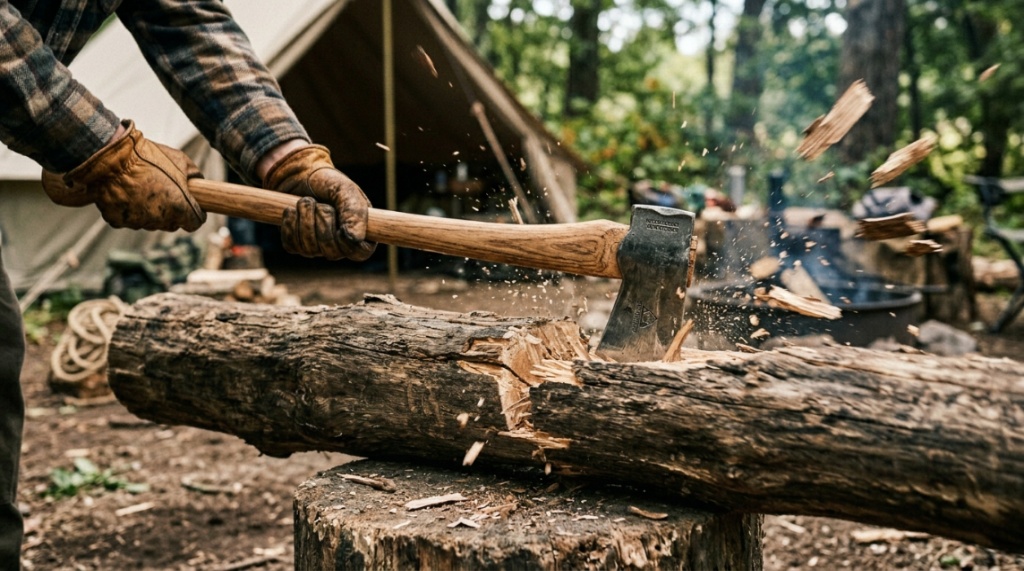
Choose a camp axe when your camping involves regular firewood splitting of rounds 5 inches or larger, when you car camp or base camp (no long carries), or when you need sustained wood processing for group fires or cold-weather heating.
Specific scenarios where a camp axe wins:
- Car camping with fire pits: You have access to larger wood and need to split it efficiently. A camp axe handles 6- to 8-inch rounds that a hatchet simply cannot power through.
- Winter camping: Cold weather demands more firewood. A camp axe processes volume faster, keeping you warm without exhausting yourself.
- Group camping: Feeding a fire for 4–8 people requires serious wood volume. A camp axe is the only practical hand tool for this scale.
- Base camp setups: Multi-day stays at one location justify the weight because you carry it once and use it repeatedly.
- Shelter building: Constructing lean-tos or log structures requires cutting and notching larger timber that hatchets cannot handle.
The camp axe shines whenever task demands exceed what a one-handed, sub-1.5-pound tool can deliver. If you find yourself repeatedly striking the same spot because your hatchet lacks the force to complete a split, you need a camp axe.
When Is a Hatchet the Better Choice?
A hatchet is the better choice for backpacking, ultralight camping, solo trips with minimal fire needs, bushcraft carving tasks, and any situation where every ounce of pack weight matters.
Hatchet-preferred scenarios:
- Multi-day backpacking: Saving 1–1.5 lbs over a camp axe compounds over miles. A hatchet handles trail-available kindling (dead branches, small standing dead wood) without the weight penalty.
- Solo camping with small fires: One person needs far less firewood. A hatchet processes enough kindling and small splits for a solo cooking fire in 10 minutes.
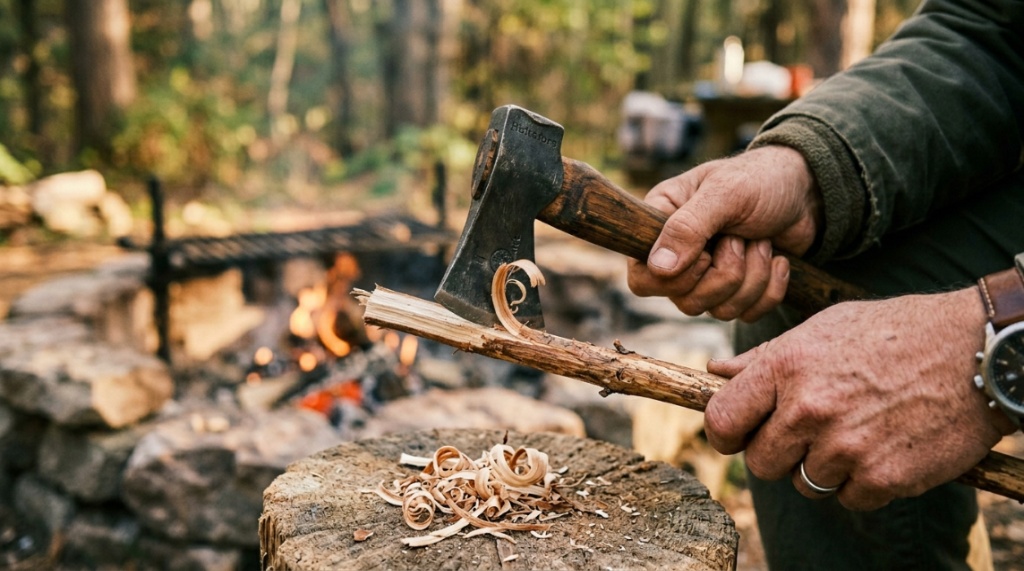
- Bushcraft and carving: The shorter handle gives superior control for spoon carving, stake shaping, trap building, and fine woodwork that camp axes make awkward.
- Canoe portaging: Every pound matters during carries between waterways. A hatchet rides in a thigh pocket or belt loop without affecting balance.
- Summer camping: Warm weather means smaller fires (if any). A hatchet handles the minimal wood processing summer camping requires.
The hatchet wins whenever portability outweighs raw splitting power. If your firewood comes from dead branches and small standing timber rather than large rounds, a hatchet does everything you need at half the weight.
Choosing between an axe and a hatchet often comes down to balancing cost with performance. The same rule applies when shopping for your workshop; knowing how to find affordable cordless power tools without losing quality ensures you get dependable gear for your DIY projects at the right price
Can One Tool Do Both Jobs?
A 14- to 16-inch camp axe weighing around 1.75 lbs comes closest to bridging both roles, offering reasonable splitting power with acceptable portability — but it compromises in both directions rather than excelling at either.
This middle-ground tool exists and works for campers who:
- Take weekend trips (2–3 nights) with moderate hiking distances
- Process medium wood (4–6 inch rounds) occasionally
- Want one tool rather than choosing between two
- Camp in three-season conditions without extreme cold
The compromise means you carry slightly more weight than a pure hatchet user and have slightly less splitting power than a dedicated camp axe user. For many recreational campers, this trade-off works perfectly. The Husqvarna Carpenter’s Axe (1.75 lbs, 15-inch handle) and the Council Tool Hudson Bay (2 lbs, 18-inch handle) both occupy this middle ground effectively.
However, specialists — serious backpackers or dedicated wood processors — benefit from choosing the right tool for their primary task rather than compromising with a hybrid.
How Does Swing Technique Differ Between Camp Axes and Hatchets?
Camp axes use a two-handed overhead swing with a sliding grip for maximum force, while hatchets use a one-handed controlled chop with wrist snap for precision and speed.
The technique difference matters for both safety and efficiency:
Camp axe technique:
- Start with the dominant hand near the head, guide hand at the pommel
- Raise overhead with both hands
- During the downswing, slide the dominant hand down to meet the guide hand
- Follow through on the chopping block
- Requires full overhead clearance and a wide stance
Hatchet technique:
- Grip near the pommel with one hand
- Raise to shoulder height (not full overhead)
- Snap the wrist at the bottom of the swing for acceleration
- Controlled, shorter arc with less follow-through
- Can be used in tighter spaces with less clearance
The camp axe technique generates raw power through a longer lever arm and gravity. The hatchet technique generates speed through wrist acceleration and precise aim. Trying to use camp axe technique with a hatchet (full overhead swing) is dangerous — the light head accelerates too fast and becomes difficult to control. Using hatchet technique with a camp axe (one-handed wrist chop) wastes the tool’s potential and strains your wrist.
What About Cost — Is a Camp Axe or Hatchet a Better Investment?
Quality hatchets and camp axes cost roughly the same ($40–$150 for mid-range to premium), so cost should not drive the decision — match the tool to your camping style instead.
Price ranges by category:
- Budget hatchets ($15–$35): Fiskars X7, generic hardware store options
- Mid-range hatchets ($40–$80): Husqvarna Hatchet, Estwing Sportsman’s
- Premium hatchets ($90–$200): Gransfors Bruk Wildlife, Hultafors Trekking
- Budget camp axes ($20–$40): Fiskars X11, generic forestry axes
- Mid-range camp axes ($50–$100): Husqvarna Forest Axe, Council Tool Velvicut
- Premium camp axes ($100–$250): Gransfors Bruk Small Forest Axe, Wetterlings
Dollar for dollar, you get similar quality at each price tier regardless of whether you choose a hatchet or camp axe. The investment decision should be: which tool will you actually use more often? A $70 hatchet used every trip delivers more value than a $150 camp axe that stays home because it is too heavy for your hiking style.
Can You Carry Both a Camp Axe and a Hatchet?
Carrying both makes sense only for extended base camp trips, group expeditions, or winter camping where high-volume wood processing justifies the combined 3–4 pounds of cutting tools.
The two-tool system works like this:
- Camp axe: Primary splitting tool for processing large rounds into manageable pieces
- Hatchet: Secondary tool for kindling prep, feather sticks, carving, and precision tasks
This mirrors how professional woodsmen work — a larger tool for heavy processing and a smaller tool for finishing work. For recreational camping, carrying both is usually overkill. But for week-long winter camps where you burn 30+ pounds of firewood daily, the efficiency gain of having purpose-matched tools justifies the extra weight.
For detailed performance comparisons of both camp axes and hatchets tested under demanding conditions, top camp axes and hatchets reviewed in Alaska offers side-by-side evaluations that highlight real differences between the two tool categories.
Conclusion
The camp axe vs hatchet debate has no universal winner — only the right tool for your specific camping style. Choose a camp axe if you car camp, process large firewood, camp in cold weather, or support group fires. Choose a hatchet if you backpack, camp solo, prioritize weight savings, or focus on bushcraft skills. A 14- to 16-inch hybrid works for weekend warriors who want one tool without extreme specialization.
Stop overthinking it. Assess your last five camping trips honestly. Did you struggle with firewood because your tool lacked power? Get a camp axe. Did you resent carrying a heavy tool you barely used? Switch to a hatchet. Your camping history tells you exactly which tool belongs in your kit.
Camp axe or hatchet — which one lives in your pack? Share your choice and why it works for your style of camping.
Frequently Asked Questions
Is a camp axe safer than a hatchet?
Neither is inherently safer — safety depends on technique and maintenance. Camp axes require more swing clearance, increasing risk in tight spaces. Hatchets are lighter and faster, making glancing blows more common. Both are safe when used with proper stance, sharp edges, and appropriate technique for the tool size.
Can a hatchet split the same wood as a camp axe?
A hatchet splits wood up to 4–5 inches in diameter effectively. Beyond that, it lacks the mass and leverage to complete splits efficiently. A camp axe handles 6–8 inch rounds that would require excessive effort or batoning technique with a hatchet. For campfire kindling, both work equally well.
Which lasts longer — a camp axe or a hatchet?
Both last equally long with proper maintenance. Forged steel heads on either tool are essentially permanent — only the edge wears through decades of sharpening. Handles may need replacement every 5–15 years. The tool you maintain well outlasts the tool you neglect, regardless of category.
Do I need a camp axe if I already have a saw?
A saw cuts logs to length but cannot split them. A camp axe splits rounds into burnable pieces, but is inefficient at crosscutting. The two tools complement each other — a folding saw bucks logs into rounds, then a camp axe splits those rounds into firewood. For minimal kit, choose based on whether your wood source needs cutting (saw) or splitting (axe).
What size camp axe equals a hatchet in portability?
A camp axe with a 14-inch handle and 1.5-lb head approaches hatchet portability while retaining slightly more splitting power. Below 14 inches and 1.5 lbs, the tool functionally becomes a hatchet regardless of marketing labels. The portability threshold is roughly 1.75 lbs total weight and 15 inches overall length.
Should beginners start with a hatchet or a camp axe?
Beginners should start with a hatchet. The shorter handle and lighter weight make control easier to learn, reducing injury risk during the skill-building phase. Once comfortable with the hatchet technique, transitioning to a camp axe involves adapting to a longer swing arc — a simpler progression than learning full camp axe technique from scratch.
Can I throw a camp axe like a hatchet?
Camp axes can be thrown but their longer handles and heavier heads make c,consistentotation difficult compared to purpose-built throwing hatchets. For recreational throwing, use a dedicated throwing hatchet (balanced weight, straight handle, no sharp poll). Never throw your primary camp tool — a damaged edge or broken handle leaves you without a critical piece of gear.