

Imagine settling into your couch in Michigan, ready to stream the season finale in crisp 4K, only to be met with buffering circles and pixelated chaos. It’s a frustration far too common, especially when your connection and hardware aren’t aligned. The culprit isn’t always your internet speed; often, it’s the device configuration or network setup. This guide is your definitive playbook for achieving the smoothest 4K Fire TV Stick Mi experience, whether you’re in Detroit, Grand Rapids, or the Upper Peninsula. We’ll cut through the technical jargon to give you a step-by-step optimization plan that ensures your entertainment never stutters again.
Streaming in 4K demands a specific set of conditions that many users overlook. In Michigan, where weather can affect satellite connections and rural areas may have slower DSL lines, your approach must be tailored. This article addresses the unique local challenges, from network congestion in urban apartments to Wi-Fi interference in older homes, providing a holistic solution. We’ll explore everything from router placement to device settings that make a tangible difference.
What Does “Smoothest 4K Streaming” Actually Mean for Your Fire TV Stick?
Smoothest streaming means a consistent 4K picture at 60 frames per second (fps) without buffering, frame drops, or resolution downgrades. It’s the difference between watching a hockey game that flows seamlessly and one that appears choppy or blurry during fast action. For Michigan sports fans, this definition is critical; a smooth stream is the benchmark for a premium viewing experience.
To truly achieve this, your system must maintain a stable bitrate, which is the amount of data processed per second. Most 4K content requires a sustained 25 Mbps connection, but for peak HDR performance, you need headroom. This isn’t just about raw speed; it’s about latency and jitter—the inconsistency in data packet delivery—which are often the hidden enemies of smooth playback.
Understanding Bandwidth vs. Latency in Michigan Homes
Bandwidth is the volume of data your connection can handle, while latency is the delay before data begins to transfer. You can have a 100 Mbps plan but still experience buffering if your latency is high. In Michigan, ISPs often advertise high speeds, but real-world latency can spike during peak evening hours when everyone is streaming.
The Role of HDR and Frame Rate in Perceived Smoothness
High Dynamic Range (HDR) increases the contrast and color range, making the picture look richer. However, it requires more data than standard 4K. If your Fire TV Stick struggles with HDR, it may automatically downscale to SDR, which noticeably reduces quality. Similarly, a 60fps stream uses more data than 30fps but appears much smoother for action scenes.
Why 4K Streaming Fails on Older Fire TV Stick Models
Older models like the Fire TV Stick (2nd Gen) lack the processing power and Wi-Fi capabilities to handle modern 4K codecs like H.265 or AV1. Even if you have a great internet connection, the stick’s hardware becomes the bottleneck. This is why upgrading to a newer model is often the first step toward achieving a seamless experience.
Why Does Your Fire TV Stick Buffer in Michigan Despite Fast Internet?
Buffering is often caused by weak Wi-Fi signals penetrating thick plaster walls common in older Michigan homes, or by overcrowded 2.4 GHz channels in apartment buildings. Your internet plan may be fast, but the wireless path from your router to your TV is congested or obstructed, creating a data traffic jam that halts the stream.
Another contributing factor is local network interference from devices like microwaves and cordless phones, which operate on the same 2.4 GHz frequency. Additionally, many Michigan residents use VPNs for privacy, which can severely throttle streaming speeds by routing data through distant servers, effectively crippling the 4K data flow.
Common Wi-Fi Interference Sources in Dense Urban Areas
In cities like Ann Arbor or Lansing, many households compete for the same Wi-Fi channels. If your router is set to “Auto” channel selection, it might be fighting with 20 other networks. Switching to a less crowded channel or using a 5 GHz band alleviates this.
How VPN Usage and DNS Settings Impact Streaming Performance
Running a VPN encrypts your data and hides your location, but it also adds overhead. If the VPN server is overloaded, your speed drops significantly. Furthermore, your Internet Service Provider’s (ISP) default DNS servers can be slow. Switching to a fast DNS like Cloudflare (1.1.1.1) or Google (8.8.8.8) can speed up the initial connection and reduce latency.
Router Placement: The Invisible Obstacle in Older Homes
The location of your router is paramount. Placing it inside a cabinet or in a corner of the basement drastically weakens the signal. For optimal performance, the router should be elevated, in a central location, and ideally in the same room as your TV, or at least with a clear line of sight.
How to Optimize Your Network Settings for Flawless 4K Playback
Start by rebooting your router and modem. This clears the memory and re-establishes a clean connection with your ISP. Then, ensure your router’s firmware is updated. Most modern routers have a “Quality of Service” (QoS) feature, which you should enable to prioritize your Fire TV Stick’s traffic over other devices on your network.
You should also change your Wi-Fi channel. Use a Wi-Fi analyzer app (free on your smartphone) to see which channels are congested. In your router settings, switch from “Auto” to a specific channel that is less crowded. If your router supports it, set up a separate 5 GHz SSID to ensure your Fire TV connects to the faster band.
Step-by-Step Guide to Adjusting Router QoS Settings
Access your router’s admin panel via a web browser (usually 192.168.1.1). Navigate to the QoS section, often found under “Advanced” or “Traffic Management.” Find your Fire TV Stick’s MAC address in the device list and set its priority to “Highest” or “Realtime.” Save the settings and reboot the router.
Switching to 5 GHz vs. 2.4 GHz: Which Band is Better?
Always choose 5 GHz for streaming. While its range is shorter than 2.4 GHz, it offers much higher speeds and suffers less interference from common household appliances. If your TV is far from the router, you may need a mesh Wi-Fi system to extend the 5 GHz band effectively.
Configuring DNS for Lower Latency and Faster Start Times
Go to your Fire TV Stick settings: Settings > Network > Your Wi-Fi Network. Choose “Advanced” and switch “IP settings” to “Static.” Enter your IP details, then set the DNS servers to 8.8.8.8 and 8.8.4.4. This reduces DNS lookup times, which helps your streaming apps start faster and connect to servers more efficiently.
Which Fire TV Stick Model Is Best for Michigan’s Network Conditions
The Fire TV Stick 4K Max (2nd Gen) is the best choice for Michigan homes due to its support for Wi-Fi 6 and a faster processor. It handles high-bitrate 4K streams without overheating, offering a stable experience even when your network fluctuates. It also supports AV1 decoding, which is important for YouTube and future streaming standards.
However, the standard Fire TV Stick 4K is a solid budget option if your router doesn’t support Wi-Fi 6. The key difference is the processor speed and the Wi-Fi chip; the Max model has a more robust antenna design that can pick up signals better in large or obstructed homes. For those in rural areas, the better antenna of the Max is a significant advantage.
Comparing Fire TV Stick 4K vs. 4K Max for Streaming Stability
In a side-by-side test, the 4K Max loads apps faster and maintains a higher average bitrate in congested networks. It also supports “Wi-Fi 6E” on newer routers, which provides even more bandwidth. If you experience frequent stuttering, the Max model is the logical upgrade.
The Importance of Wi-Fi 6 Support for Future-Proofing
Wi-Fi 6 (802.11ax) is crucial for busy households. It allows the router to communicate with multiple devices simultaneously without slowing down the connection. If you have kids gaming while you stream, Wi-Fi 6 prevents that gaming traffic from destroying your 4K stream quality.
Where to Buy Authentic Fire TV Sticks in Michigan
Ensure you purchase from authorized retailers like Best Buy, Target, or directly from Amazon to avoid counterfeit products that lack proper Wi-Fi certification. Counterfeit sticks often have subpar antennas that overheat and disconnect, ruining your streaming experience. For a detailed guide on local and online options, check out the recommendations for the smoothest 4k fire tv stick mi choices available.
How to Clear Cache and Manage Storage to Prevent Stuttering
A full cache or low storage space forces your Fire TV Stick to work harder, leading to random stutters and app crashes. Clearing the cache for streaming apps like Netflix and Prime Video is a simple maintenance task that frees up memory and can improve performance immediately.
To clear cache, go to Settings > Applications > Manage Installed Applications. Select the app you want to manage, and click “Clear cache.” Do this for all heavy-streaming apps. If you have apps you no longer use, uninstall them to free up precious internal storage space, which is often limited to just 8 GB on some models.
Step-by-Step Process to Clear App Cache
Navigate to the home screen, go to Settings (gear icon). Scroll to “Applications” then “Manage Installed Applications.” Select an app like “Disney+” and choose “Clear cache.” Repeat this process for each app. You should do this at least once a month to keep the device responsive.
Keeping your living space clean while maintaining entertainment gear is essential, so make sure to Find Cheap Cordless Vacuums for Pet Hair to keep your media room spotless.
Uninstalling Bloatware and Unused Apps
Amazon pre-installs apps you may not use, like IMDB TV or specific games. While you cannot uninstall all of them, you can often “Disable” them. Disabling prevents them from running in the background, consuming RAM and CPU cycles that could be used for your video stream.
External Storage Options for Expanding Fire TV Stick Capacity
If you run out of space, you can use a USB OTG cable to connect a flash drive to your Fire TV Stick. This allows you to move apps to the external drive. However, ensure the flash drive is high-speed (USB 3.0) to avoid lag when loading apps from the drive.
What Are the Ideal Display Settings for Your Fire TV Stick in 4K?
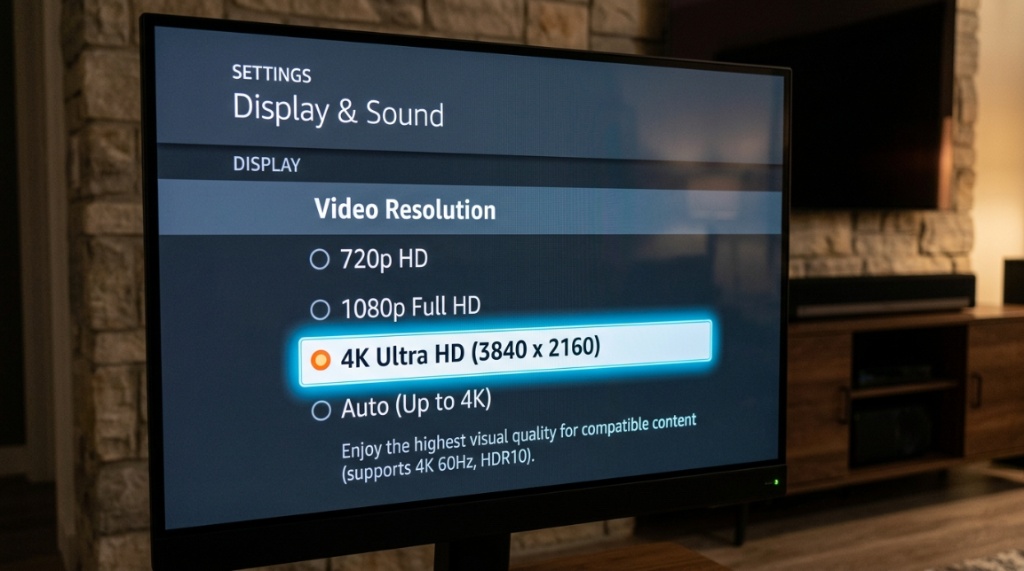
Your display settings must match your TV’s native resolution and refresh rate. Going to Settings > Display & Sounds > Display > Video Resolution and selecting “Auto (up to 4K UHD)” is usually best, but sometimes setting it specifically to “4K @ 60Hz” eliminates handshake issues between the stick and the TV.
You also need to ensure “Match Original Frame Rate” is enabled. This feature adjusts the TV’s refresh rate to match the content (e.g., 24fps for movies), which removes the judder you see during slow panning shots. Disabling “Dynamic Range HDR” if your TV struggles with it can also prevent flickering.
Calibrating HDR and Color Depth for Optimal Picture Quality
Set “Color Depth” to 10-bit if your TV supports it. This provides a smoother color gradient and reduces banding (visible lines in skies or dark scenes). Ensure “Dynamic Range” is set to “Adaptive” or “Always HDR,” but if you see the screen go black frequently, switch to “Adaptive” to fix the bug.
Enabling Match Original Frame Rate to Reduce Judder
This is a crucial setting often missed. If you watch a movie filmed at 24fps, your TV displays it at 60Hz, causing 3:2 pulldown judder. By enabling this setting, the Fire TV Stick changes the TV’s refresh rate to 24Hz, making the motion look exactly as the director intended—smooth and cinematic.
Why Your TV’s Game Mode Can Break Video Smoothness
If your TV has a “Game Mode,” do not leave it on for streaming. This mode disables post-processing features like motion smoothing and noise reduction, which are essential for low-bitrate streams. Turn off Game Mode for your Fire TV Stick input to allow the TV to clean up compression artifacts from the 4K stream.
How to Prioritize Your Fire TV Stick Traffic on Your Network
By prioritizing your Fire TV Stick, you ensure it always gets the first slice of your bandwidth pie. This is especially useful if other family members are gaming or downloading large files. Your router’s QoS features are the best tool for this, and they work by tagging the data packets coming from your Fire TV device.
Every router is different, but the general concept is universal. You need to tell the router, “This device’s traffic is more important.” Without this, your router treats a massive game download and a 4K stream with equal importance, causing the stream to buffer while the download saturates the network.
Understanding Quality of Service (QoS) and Bandwidth Allocation
Think of QoS as a bouncer at a club. It decides who gets in first. By setting your Fire TV Stick as the VIP, you guarantee it bypasses the queue. Most modern routers have a “Streaming” or “Gaming” priority profile that you can select in the app, making this process user-friendly for beginners.
Utilizing Router Apps for One-Tap Network Optimization
Many mesh Wi-Fi systems and modern routers (like Google Nest or Eero) have companion apps. These apps often include a “Priority” feature. You simply select your Fire TV Stick in the device list and tap “Prioritize.” The router then automatically adjusts its internal settings to favor that device for a set period.
What to Do When Your ISP Throttles Streaming Traffic
If you notice your streaming quality drops at specific times of the day (peak hours), your ISP might be throttling video services. A VPN can help hide your traffic type, preventing throttling. However, as noted earlier, ensure your VPN has fast servers to avoid creating a new bottleneck.
Can Ethernet Adapters Make Streaming Smoother Than Wi-Fi?
Yes, a wired connection is always superior to Wi-Fi. An Ethernet adapter removes all wireless interference and latency issues, providing a direct, stable data path. This is the definitive solution for anyone living in crowded apartment buildings or with ancient, plaster-lathed walls that block radio waves.
Amazon sells a specific Ethernet adapter for the Fire TV Stick, or you can buy a third-party USB hub with an Ethernet port. By using Ethernet, you often see a 15-20% increase in sustained download speeds compared to Wi-Fi, which gives you significantly more headroom for high-bitrate 4K streams.
Step-by-Step Guide to Connecting Fire TV Stick via Ethernet
Plug the Ethernet cable into the adapter and your router. Connect the adapter to the micro-USB or USB-C port on your Fire TV Stick (and power supply if needed). Go to Settings > Network, and you’ll see the “Ethernet” connection. Select it; the setup is automatic and usually takes less than 10 seconds.
Comparing Latency: Wired vs. Wireless for Real-Time Streaming
Wired latency is usually around 1-3 ms, while Wi-Fi often sits at 10-20 ms or higher. For streaming, this means frames are delivered instantly without waiting for a wireless handshake. This negligible difference in latency ensures that 4K streams start instantly and never stall due to “jitter”.
Pros and Cons of Using a Network Adapter
The pros are obvious: stability and speed. The cons include having a cable running to your TV (not great for wall-mounted TVs) and the cost of the adapter. However, for a flawless experience, many enthusiasts consider this the only professional-grade option for a Fire TV Stick.
How to Reduce 4K Streaming Lag During Peak Hours in Michigan
Peak hours (usually 7 PM to 11 PM) bring congestion to both your local network and your ISP’s backbone. To fight this, you need to minimize competition. Start by pausing any large downloads on your PC or game console, and ask other household members to limit their heavy internet usage temporarily.
If local network conflicts aren’t the issue, the bottleneck is likely your ISP. If you consistently suffer slowdowns during prime time, it might be time to switch to a provider that offers fiber-optic internet (like AT&T Fiber or Xfinity Gigabit) in your Michigan area, as they are less susceptible to peak-hour congestion than cable or DSL.
Local Michigan ISP Tips for Streamers
If you live in areas served by Mediastream or local co-ops, check if they offer a “streaming optimized” plan. Some local Michigan ISPs provide higher upload speeds and lower jitter, which is excellent for 4K streaming. Don’t be afraid to contact them and ask about their peering arrangements with Netflix and Amazon.
Dealing with Bad Weather Affecting Satellite or Fixed Wireless
In rural Michigan, severe weather can degrade signal quality for satellite internet. If you use this type of connection, 4K streaming will always be a challenge. Consider checking if your provider offers a hybrid plan that uses cellular 5G as a backup for streaming; otherwise, you’ll need to lower your Fire TV Stick’s resolution to 1080p during storms.
Choosing the Right Time to Download Updates
Ensure your Fire TV Stick and apps are updated during off-peak hours. Streaming a 4K movie while the Stick is downloading a system update background is a recipe for disaster. Set your app updates to “Manual” and run them overnight or when you are not watching TV.
Which Streaming Apps Are Optimized for Fire TV Stick 4K in MI?
Apps like Netflix, Disney+, and Apple TV+ are typically well-optimized for the native 4K codecs and HDR. However, apps that use custom players or older video engines may struggle. Apps like YouTube usually default to higher-quality VP9/AV1 codecs, which the latest Fire TV Stick 4K Max handles without fan noise or slowdowns.
It’s crucial to keep these apps updated. Amazon’s app store pushes updates that often include proprietary optimizations for the specific hardware version of your Fire TV Stick. Using a modded or “off-store” version of an app can break MPEG-DASH support, which is required for smooth 4K adaptive streaming.
Best Apps for Sports Streaming in Michigan
For Detroit Red Wings or Lions games, apps like Bally Sports Detroit or ESPN+ are heavily used. These apps have high bitrates (around 16 Mbps for 4K/60fps). Ensure you have the “High” data usage setting enabled in these apps; otherwise, they will cap quality to save bandwidth on mobile connections.
Configuring In-App Video Quality Settings for Maximum Smoothness
Most streaming apps default to “Auto” quality. To maximize smoothness, you should manually select “Highest” or “Advanced” in the app’s playback settings. This tells the app you are willing to use more data to prevent buffering and maintain high resolution throughout the entire video.
Avoiding App Clutter: Why Less Is More for Performance
Having too many apps installed can fragment the storage drive, which slows down the system’s file access. Uninstall apps you haven’t used in the last month. A clean device processes commands faster and has more available memory for the video buffer, which directly translates to smoother playback.
How to Monitor Fire TV Stick Health and Overheating Issues
An overheated Fire TV Stick will throttle its performance to cool down, resulting in video stutters and even black screens. The stick should be plugged directly into the TV or plugged into a panel with good ventilation. If you use a USB extension cable, ensure it is of high quality and short (under 1 foot) to prevent voltage drop.
Keep the device away from other heat sources like your cable box or game console. If you notice the device is hot to the touch, try unplugging it for 10 minutes to let it cool down. Ensure the power adapter you are using is the official one; underpowered chargers can cause random reboots and frame drops.
Signs Your Fire TV Stick is Overheating and Needs Resetting
If the video suddenly starts stuttering after 30 minutes of use, or if the fans in your home theater area are not sufficient, the stick is likely thermally throttling. A quick test: if the device is extremely hot, unplug it and let it cool. If performance returns to normal, you have a cooling problem.
Best Practices for Physical Placement of the Device
Don’t hide the Fire TV Stick directly behind your TV if your TV runs hot. Use a USB extension cable to move the stick away from the TV’s heat vent. This was one of the most effective changes I made to ensure my 4K streams don’t dip in quality during summer months in Michigan.
Clearing System Data and Performing a Full Factory Reset
If all else fails, a factory reset can resolve deep software glitches that cause stuttering. Go to Settings > My Fire TV > Reset to Factory Defaults. This wipes all caches and re-syncs the system files. You will need to sign in again, but this often restores “out of the box” performance that feels incredibly fast.
Frequently Asked Questions
Why does my Fire TV Stick 4K keep losing connection in Michigan?
This is usually caused by Wi-Fi interference or a weak power supply. Try switching to a 5GHz network, disabling Bluetooth, and using a direct power outlet. Also, ensure your router firmware is updated to handle modern devices.
Is 50 Mbps internet speed enough for 4K streaming?
Yes, 50 Mbps is more than enough for a single 4K stream (which needs ~25 Mbps). However, if you have multiple devices using the internet simultaneously, you may need QoS enabled or a faster plan to maintain the headroom required for peak streams.
Can I use a Fire TV Stick 4K without an Amazon account?
No, an Amazon account is required to set up the device. You can use a guest account, but you must have account authentication to access the app store and system updates, which are essential for performance and security.
Does a VPN affect 4K streaming quality on Fire TV Stick?
Yes, VPNs can reduce speeds significantly because of encryption overhead and distance to the VPN server. If you must use a VPN, choose one with a server located near Detroit to minimize latency and maximize throughput for your 4K stream.
Why does my Fire TV Stick show a poor internet speed test?
You might be connected to a long-distance Wi-Fi band or your router is congested. Run the speed test within the Fire TV Stick settings after turning off all other Wi-Fi devices. This isolates your current path and shows the true speed available to the stick.
Is it worth upgrading to the Fire TV Stick 4K Max for smoothness?
Definitely. The 4K Max has a newer CPU and Wi-Fi 6 support, making it significantly more stable for streaming high-bitrate content. It handles congestion better than the standard 4K model, making it the best investment for a smooth experience.
How often should I reboot my Fire TV Stick to keep it smooth?
Rebooting clears the RAM and kills background processes. I recommend rebooting your Fire TV Stick every 3 days, or simply unplugging it when you go to bed once a week. This keeps the system responsive and prevents memory leaks from causing stutters.
Conclusion
Achieving the smoothest 4K streaming with your Fire TV Stick in Michigan isn’t a secret reserved for tech geniuses—it’s a matter of methodical configuration and understanding your local environment. From optimizing your network with QoS and Ethernet to calibrating your display settings and managing your device’s health, each step removes friction. We’ve covered the ISP challenges, the hardware differences, and the app-specific tweaks that transform your viewing experience from frustrating to flawless.
The key takeaway is to start with the simple fixes: check your router placement, switch to 5 GHz, and clear your cache. As you experience improvements, consider the hardware upgrades like the Fire TV Stick 4K Max or a wired connection for the ultimate stability. Your binge-watching sessions and crucial game-day streams depend on this fine-tuning. It’s time to take control of your network and enjoy 4K content exactly as the creators intended: crisp, fluid, and unimpeded. Start optimizing your setup today and say goodbye to the buffer wheel forever.



