

Shopping for baby gear can feel overwhelming, especially when you’re trying to find products that will last through your child’s early years. Portable baby swings offer convenience and comfort for both parents and babies. However, choosing the right one requires careful consideration of weight limits and how they align with your baby’s growth.
Understanding weight capacity isn’t just about safety. It’s also about getting the most value from your purchase. A swing that accommodates your baby from birth through the toddler years provides better long-term benefits than one that becomes obsolete after a few months. This guide will help you navigate the important factors to consider when evaluating weight limits before making your purchase.
Why Weight Limits Matter More Than You Think
Weight limits exist for crucial safety reasons. Manufacturers test their products under specific conditions and set maximum weight capacities based on those tests. Exceeding these limits can compromise the swing’s structural integrity, potentially leading to accidents or injuries.
Beyond safety, weight limits affect the swing’s functionality. A baby who exceeds the recommended weight might cause the motor to strain or fail. The swing might not move smoothly, defeating its purpose of soothing your child. Additionally, the frame could become unstable, creating a tipping hazard.
Parents often underestimate how quickly babies grow. During the first year, babies typically triple their birth weight. A newborn weighing seven pounds might reach 21 pounds by their first birthday. Therefore, selecting a swing with adequate capacity ensures you won’t need to replace it sooner than expected.
Financial considerations also come into play. Baby products represent a significant investment. Choosing a swing with a higher weight limit means you’ll use it longer, making it more cost-effective. Instead of buying multiple swings as your baby grows, one well-chosen product can serve your family for an extended period.
Understanding Standard Weight Categories
Most portable baby swings fall into specific weight range categories. Understanding these categories helps you match a product to your needs and timeline.
Entry-level swings typically accommodate babies up to 20 pounds. These products work well for newborns and young infants but have a relatively short usable lifespan. Most babies reach this weight between four and six months of age. While these swings are often more affordable, they require replacement fairly quickly.
Mid-range swings usually support babies up to 25 or 30 pounds. This capacity extends usefulness through most of the first year and sometimes beyond. These swings offer a better balance between initial cost and longevity. Many parents find this weight range provides adequate value without requiring an upgrade too soon.
Heavy-duty swings can accommodate children weighing 35 to 40 pounds or more. These products serve families from the newborn period well into the toddler years. Although they typically cost more upfront, they eliminate the need for replacement and can sometimes be used for multiple children in a family.
Convertible models offer flexibility by transforming from swings into other products like bouncers or rockers. These often have varying weight limits depending on the configuration. For example, the swing function might accommodate 25 pounds, while the rocker configuration might support 40 pounds.
Reading and Interpreting Product Specifications
Product specifications contain critical information, but they can be confusing if you don’t know what to look for. Learning to interpret this information accurately helps you make informed decisions.
The weight limit is usually listed prominently in the product description. However, pay attention to whether this refers to the maximum weight or recommended weight. Some manufacturers list a recommended weight that’s lower than the absolute maximum for optimal performance.
Age recommendations appear alongside weight limits but shouldn’t be your primary decision factor. Babies grow at different rates, making weight a more reliable indicator than age. A four-month-old might weigh anywhere from 12 to 18 pounds depending on individual growth patterns. Therefore, focus on weight capacity rather than age ranges.
Look for information about what happens when weight limits are approached. Some swings maintain full functionality up to the maximum weight. Others might experience reduced swing speed or motion range as babies get heavier. Understanding these performance characteristics helps set realistic expectations.
Check whether the weight limit applies to the baby alone or includes additional items. Some parents add toys, blankets, or cushions to swings. These extras add weight that counts toward the total capacity. Clarifying this detail prevents accidentally exceeding safe limits.
Tracking Infant Growth Stages and Swing Usage
Babies grow rapidly, and understanding typical growth patterns helps you anticipate how long a swing will remain useful. Each infant growth stage brings different needs and considerations for swing usage.
Newborns typically weigh between six and nine pounds. During this stage, they need maximum support and gentle motion. Most swings easily accommodate newborns, but some require infant inserts for proper positioning. These inserts might have their own weight restrictions, sometimes limiting use to babies under 15 pounds.
Between two and four months, babies develop better head and neck control. They typically weigh 11 to 17 pounds during this period. This stage represents peak swing usage for many families. Babies are alert enough to enjoy the motion but not yet mobile enough to try climbing out.
From four to six months, babies usually weigh 14 to 20 pounds. They become more active and curious about their surroundings. Some babies lose interest in swings during this stage, while others continue enjoying them. Weight becomes a more pressing consideration as babies approach the lower end of typical weight limits.
Between six and twelve months, babies typically weigh 16 to 25 pounds. Many start crawling and pulling themselves up. Their increased mobility means they might not stay in swings as willingly. However, families with higher-capacity swings can still use them for calm-down time or naps.
Toddlers over one year old might weigh anywhere from 22 to 30 pounds or more. Very few swings accommodate this weight range. Those labeled as newborn to toddler swing options typically have weight limits of 35 pounds or higher, allowing continued use through the second year when appropriate.
Evaluating Swing Capacity for Your Specific Needs
Every family’s situation is unique. Evaluating your specific circumstances helps determine which swing capacity works best for you.
Consider your baby’s size at birth and any relevant family history. If you or your partner were larger babies, your child might follow similar growth patterns. Conversely, smaller parents often have smaller babies. While not a guarantee, genetics can provide clues about growth trajectory.
Think about your planned usage duration. Some parents view swings as short-term solutions for the first few months. Others hope to use them throughout the first year or beyond. Your intended timeline should influence the weight capacity you choose. Additionally, consider whether you plan to have more children. A higher-capacity swing can serve multiple children over several years.
Space constraints might affect your decision. Higher-capacity swings are sometimes bulkier and heavier. If you live in a small space or need maximum portability, you might accept a lower weight limit in exchange for a more compact design. However, many modern high-capacity swings offer space-efficient designs.
Budget considerations play a role, but remember that cheaper isn’t always more economical. A $60 swing that lasts four months costs more in the long run than a $150 swing that lasts eighteen months. Calculate the cost per month of use to compare true value.
Safety Features Beyond Weight Limits
While swing capacity is crucial, other safety features work together to protect your baby. Evaluating these elements alongside weight limits provides a comprehensive safety assessment.
Harness systems keep babies secure in the swing. Three-point harnesses work for younger babies, while five-point harnesses offer better security as babies become more active. Ensure the harness adjusts to accommodate your growing baby throughout the weight range the swing supports.
Frame stability matters as babies get heavier. Look for wide bases and non-slip feet that prevent tipping. Some swings have stability issues when used at maximum weight capacity. Reading customer reviews can reveal real-world experiences with frame stability.
Motor quality affects both longevity and safety. Cheaper motors might struggle with heavier babies, causing overheating or failure. Quality motors maintain consistent performance across the entire weight range. Listen for unusual sounds when testing swings in stores, as these might indicate motor strain.
Material quality impacts overall safety and durability. Fabric should be tear-resistant and securely attached to the frame. Plastic components should feel sturdy rather than flimsy. Metal parts should show quality construction without sharp edges or weak welds.
Certification marks indicate the product meets safety standards. Look for JPMA (Juvenile Products Manufacturers Association) certification in the United States. This certification means the swing has undergone testing for safety, including weight capacity verification.
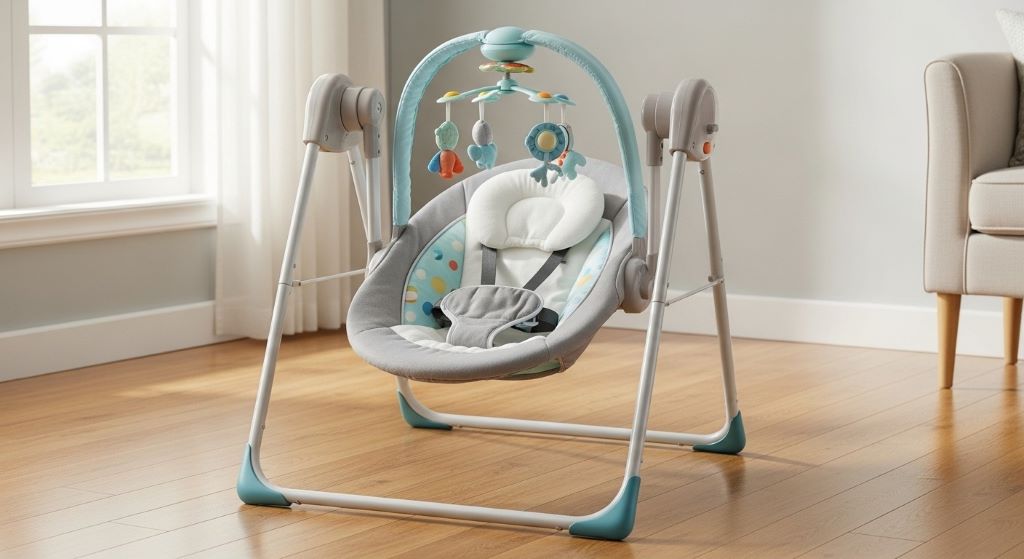
Testing Weight Limits in Real-World Conditions
Manufacturer testing occurs in controlled environments that might not reflect real-world usage. Understanding how actual conditions affect weight limits helps you use swings safely.
Wear and tear gradually reduce a swing’s effective weight capacity. Springs loosen, fabric stretches, and joints wear down over time. A swing that safely held 25 pounds when new might become unsafe at that weight after extensive use. Regular inspection helps identify wear that affects safety.
Multiple daily uses accelerate wear compared to occasional use. A swing used three hours daily experiences more stress than one used for 20-minute sessions. Factor in your expected usage intensity when considering how long a swing will remain safe at higher weights.
Environmental factors matter too. Humidity affects electronic components. Dust accumulation can interfere with moving parts. Temperature extremes impact plastic and metal components. These factors can reduce the swing’s safe weight capacity over time.
Previous ownership affects safety if you’re considering used swings. You don’t know the product’s full history, including whether it was ever overloaded or damaged. If buying used, err on the side of caution by using the swing for babies well below the stated weight limit.
Making Smart Comparisons Between Models
With numerous swing options available, systematic comparison helps identify the best choice for your family. Focusing on key factors streamlines the decision-making process.
Create a comparison chart listing models you’re considering along with their specifications. Include weight limits, price, features, and customer ratings. Visual comparison makes differences clearer and helps identify the best value.
Read customer reviews focusing specifically on weight limit experiences. Look for comments from parents whose babies approached or reached the maximum weight. They provide insight into how well the swing performs at capacity. Pay attention to mentions of motor strain, stability issues, or decreased functionality.
Consider the brand’s reputation for quality and customer service. Established brands often provide better support if problems arise. They’re also more likely to honor warranties and provide replacement parts. Research the company’s track record with product recalls or safety issues.
Look at warranty terms as an indicator of quality. Longer warranties suggest the manufacturer stands behind their product’s durability. Pay attention to what the warranty covers, especially regarding motor failure or structural issues that might relate to weight capacity.
Understanding Age and Developmental Milestones
While weight limits provide hard boundaries, developmental milestones offer additional guidance for safe swing usage. Combining both considerations creates a complete picture of appropriate usage.
Babies develop head and neck control around two to four months. Before this milestone, they need proper support in swings. Some swings offer newborn inserts that provide necessary support but might have lower weight restrictions than the main seat.
Sitting independently typically happens between four and seven months. Once babies can sit unassisted, they might prefer other positions to swings. However, many continue enjoying gentle motion even after achieving this milestone. Their increased strength means they might try to twist or rock in ways that strain the swing mechanism.
Pulling up and standing usually begins between eight and twelve months. Babies attempting these movements in swings create safety hazards regardless of weight limits. Once your baby tries to stand or climb out, it’s time to discontinue swing use even if they’re under the weight limit.
Attention span changes affect swing enjoyment. Young infants might relax in swings for extended periods. Older babies and toddlers often prefer more interactive activities. Consider whether your child’s temperament and developmental stage align with continued swing use as they approach weight limits.
Maximizing Your Investment
Getting the most value from your baby swing purchase involves strategic planning and proper maintenance. These practices extend usable life and enhance safety.
Register your product immediately after purchase. Registration ensures you receive safety notices and recall information. It also activates the warranty, which might be necessary if defects appear.
Follow all maintenance instructions provided by the manufacturer. Regular cleaning prevents buildup that can interfere with mechanical parts. Inspect the swing frequently for loose screws, worn fabric, or other signs of wear. Addressing minor issues promptly prevents them from becoming safety hazards.
Store the swing properly if you plan to use it for future children. Clean it thoroughly before storage. Keep it in a climate-controlled environment to prevent damage from humidity or temperature extremes. Save all original components, including inserts and instruction manuals.
Know when to stop using the swing. Discontinue use when your baby reaches the weight limit or shows signs of attempting to climb out. Don’t be tempted to keep using it “just a little longer” as babies approach maximum capacity. Safety should always take priority over convenience.
Making the Final Decision
After researching weight limits, safety features, and your family’s needs, you’re ready to make an informed decision. A few final considerations help ensure you choose wisely.
Prioritize safety over features. A swing with a higher weight capacity but fewer entertainment options is better than one with lights and music that your baby will outgrow quickly. Remember that the swing’s primary purpose is providing a safe place for your baby.
Consider your baby’s current weight and typical growth rates. If your two-month-old already weighs 15 pounds, a swing with a 20-pound limit won’t last long. Choose a product that accommodates your baby’s specific growth pattern rather than average statistics.
Think about portability needs honestly. If you’ll primarily use the swing in one location, a sturdier, higher-capacity model makes sense. However, if you need to move it frequently between rooms or take it on trips, balance capacity against practical portability.
Don’t forget about your home’s aesthetic if that matters to you. You’ll look at this swing daily for months. Choosing one that fits your style makes the investment more pleasant. Fortunately, many high-capacity swings now come in attractive designs.
Conclusion
Checking weight limits before buying a portable baby swing is essential for safety, value, and long-term satisfaction. Understanding how infant growth stages affect swing usage helps you choose a product that serves your family throughout the period when swings are most beneficial. A newborn to toddler swing with adequate swing capacity provides the best return on investment while ensuring safety as your baby grows.
Remember that weight limits aren’t just numbers on a box. They represent careful engineering and safety testing. Respecting these limits protects your child while maximizing the product’s lifespan. By considering your baby’s current size, expected growth, and your family’s specific needs, you can select a swing that provides months or even years of safe, reliable use.
Take time to research different models, read reviews, and understand the specifications. This investment in research pays off through peace of mind and a product that truly meets your needs. Your baby’s safety and comfort depend on making an informed choice, and understanding weight limits is a crucial part of that decision-making process.
Frequently Asked Questions
What happens if my baby exceeds the swing’s weight limit?
Exceeding the weight limit creates serious safety risks including frame instability, motor failure, and potential tipping. The swing might not function properly, and structural components could break. Always discontinue use when your baby reaches the maximum weight, even if the swing still seems to work. The manufacturer’s testing doesn’t cover weights above the stated limit, meaning safety cannot be guaranteed.
Can I use a swing for twins if they’re each under the weight limit?
No, baby swings are designed for one child at a time. Even if two babies together don’t exceed the weight limit, the swing isn’t engineered for dual occupancy. The weight distribution, harness system, and frame design all assume a single user. Using a swing for twins creates serious safety hazards and voids the product warranty.
How do I know if my baby has outgrown the swing besides weight?
Signs your baby has outgrown the swing include attempting to climb or stand in it, showing discomfort or appearing cramped, consistently refusing to stay in the swing, or the harness no longer fitting properly. Developmental readiness matters as much as weight. Once babies become mobile and curious enough to try escaping, it’s time to retire the swing regardless of their weight.
Are weight limits different for battery-operated versus plug-in swings?
Weight limits depend on the structural design rather than the power source. However, battery-operated swings might experience reduced performance with heavier babies because batteries provide less consistent power than electrical outlets. Both types should have clearly stated weight limits. Choose based on capacity needs rather than power source, though plug-in models often maintain better performance with heavier babies.
Should I buy a higher capacity swing even if my baby is small?
Yes, choosing a higher capacity swing is generally wise even for smaller babies. Babies grow quickly and unpredictably. A swing with a higher weight limit provides longer usability and better value. Most high-capacity swings include newborn inserts that safely accommodate smaller babies, giving you the best of both worlds. The small additional cost upfront typically saves money compared to replacing a lower-capacity swing sooner.
Related Topics:
How to Clean Baby Stroller Fabric: The Ultimate Guide for Parents
What to Wear to a Baby Shower: A Complete Guide



