

You’ve probably seen the FunWater inflatable paddle board flash across your screen with a price tag that seems almost too good to be true. Whether you’re a seasoned paddler looking for a budget backup or a complete beginner trying to avoid a hefty investment, the question remains the same: is this board actually good, or are you just buying a headache? We’ve broken down the specs, the real-world trade-offs, and the longevity factors to give you a definitive answer. In this honest funwater stand up paddle board review, we will dissect whether this budget-friendly option deserves a spot in your garage or if you should save your cash for a higher-tier model.
Key Takeaways
- Target Audience: The FunWater SUP is best suited for casual paddlers, lighter riders, and beginners who prioritize affordability over high-end performance.
- Stability Trade-offs: While the wide nose offers initial stability, the thick profile can catch wind, making it harder to paddle in choppy conditions than more streamlined boards.
- Construction Quality: It utilizes single-layer PVC (Polyvinyl Chloride) construction, which is durable enough for gentle use but more susceptible to pressure blisters and dings than double-layer boards.
- Accessories Matter: A significant portion of the value lies in the included kit—specifically the pump and backpack—which are often the first points of failure on budget boards.
- Warranty vs. Support: The 1-year warranty is standard, but customer support response times can be slower than premium brands. Consider the board a “seasonal” purchase rather than a decade-long investment.
Brand Overview and Market Positioning
FunWater is a brand that has carved out a niche in the “budget tier” of the paddle board market. They compete directly with brands like SereneLife and Rocoo in the sub-$400 category. Unlike premium brands such as Red Paddle Co or iRocker, FunWater focuses on volume and accessibility. They aim to lower the barrier to entry for paddle boarding, making it financially accessible to families and college students. Their Oregon line, in particular, has gained traction among those looking for a stylish but inexpensive option. For a deeper dive into their specific Oregon model deals, you might want to read more about this specific journey. However, the core question isn’t just about price; it’s about whether the savings justify the compromises you make in performance and durability.
Unboxing and Inflated Specifications
When you order a FunWater board, it arrives in a large box containing the board, the pump, a coiled leash, a repair kit, a paddle, and a backpack. The initial impression is usually positive because the included travel bag is often better than what competitors include at a similar price point.
Inflated Dimensions and Rider Weight
The most common FunWater model measures 10’6″ in length and 32″ in width. This is a standard “all-around” shape. However, the thickness is where we see a potential issue. It inflates to a thickness of 6 inches, which helps with rigidity but also increases drag in the water. The board is rated for riders up to 280 pounds (approximately 127kgs), but this rating assumes calm, flat water. If you are over 200 pounds, you will likely find the board feels slightly bogged down and may struggle to keep the nose from plowing in light chop.
Double vs. Single Layer Construction
Most FunWater boards use a single-layer PVC (Polyvinyl Chloride) construction. In simple terms, this means there is one layer of PVC over the drop-stitch core. Premium boards use a double-layer or woven fabric layer for added stiffness and puncture resistance. The implication for you is that while the FunWater feels firm when you first inflate it to 15 PSI (Pounds per Square Inch), it may start to soften slightly during a long session in hot sun. It is also more vulnerable to abrasion if you slide it over rough sand or rocky launches,To maximize your board’s performance on the water, check out our guide on Upgrade Your Board with Ocean Plastic Surfboard Fins.
Stability, Hull Shape, and Paddling Performance
This is the section where we determine if the FunWater actually floats well or just floats. We need to distinguish between “initial stability” (how steady it feels when standing still) and “secondary stability” (how well it recovers when you shift your weight).
Initial Stability vs. Secondary Stability
The board features a wide, rounded nose and a planing hull. This creates a very stable platform for beginners. When you step on it, the displacement of the wide body makes it feel like a raft—it doesn’t tip easily. However, the lack of a defined rail (the edge of the board) means it doesn’t carve or track well. When you paddle, you will notice the nose drifts side to side, requiring a paddle stroke correction every 3-4 strokes to keep a straight line. Experienced paddlers will find this “wobble” frustrating, but beginners who prioritize standing up without falling will appreciate the forgiveness.
Wind and Choppy Water Performance
This is the most significant weakness of this board design. Because it is 6 inches thick and lacks a streamlined profile, it acts like a sail. If you are paddling into a headwind of 10-15 mph, you will feel every gust pushing the nose sideways. The board tends to spin out of control if you don’t keep constant tension on the paddle. If your local paddling spot is an ocean bay or a large lake prone to afternoon winds, this board will turn a relaxing paddle into a workout against the elements. In truly flat, protected water like a small lake or a slow-moving river, it performs perfectly fine.
Weight, Portability, and the Inflation Process
Portability is often a deciding factor for choosing an inflatable over a hardboard. However, “inflatable” does not equal “lightweight.”
The Pump and Inflation Time
The FunWater includes a high-pressure hand pump, not an electric one. Inflating this board to the required 15 PSI using the provided pump takes approximately 10 to 15 minutes of continuous effort. This is a significant cardio workout. To prevent the board from warping or developing creases, you need to get the PSI (Pounds per Square Inch) right. Under-inflation (below 12 PSI) will cause the board to bend in the middle (“banana-ing”) and significantly reduce performance. If you plan to paddle frequently, we strongly recommend budgeting an additional $50-$60 for a rechargeable electric pump, as manual inflation quickly becomes a chore that deters you from going out.
Carrying the Board
At around 19 to 20 pounds for the board itself, the FunWater is not the lightest on the market, but it is manageable. The included backpack has shoulder straps and a chest strap. However, the straps are not heavily padded, so carrying it from your car to a beach that is a quarter-mile away will start to dig into your shoulders. The backpack also lacks a sturdy base, so you cannot stand it up straight easily; it will flop over when you try to load gear into it.
Quality of Included Accessories
While the board itself is the star, the accessories dictate how much additional money you will need to spend. Often, the “free” items included are of low quality and require replacement, negating the cheap price of the board.
Paddle and Fin System
The paddle is fully aluminum, which makes it heavier than fiberglass or carbon options. While it is adjustable, the plastic snap-button mechanism can sometimes slip under heavy pressure. The fin is a snap-in plastic “click” fin. This is convenient as it requires no tools, but it is less secure than a screw-in fin. If you hit a submerged log or rock, the plastic fin will likely snap off instead of bending. Spare fins are cheap (around $10), but it is something to be aware of.
Leash and Repair Kit
Before your first outing, inspect the ankle cuff on the coiled leash. On some budget units, the Velcro strap is small and can come undone if you are wearing thick wetsuit boots. The repair kit includes PVC patches and a small tube of glue. These are fine for fixing small pinhole punctures on the side of the board but will not reliably fix a seam leak at the rail. For a comprehensive look at how this board stacks up against competitors in terms of gear and overall use, reading a detailed funwater stand up paddle board review can provide clarity. Remember to always use the included valve wrench to ensure the air valve is sealed tightly after inflation to prevent slow leaks.
Comparing FunWater vs. Premium Boards
To understand if the FunWater is “worth it,” you must look at what your money buys you in the upper tier. You are not just paying for inflated plastic; you are paying for engineering.
| Feature | FunWater (Budget Tier) | Premium Board (e.g., iRocker/Red) |
|---|---|---|
| Construction | Single-layer PVC (Polyvinyl Chloride) | Dual-layer with woven drop-stitch |
| Stiffness | Flexes slightly at 15 PSI | Rigid, near hardboard feel |
| Weight | ~20 lbs (9kg) – heavier due to thick PVC | ~16-18 lbs (7-8kg) – lighter core materials |
| Tracking | Requires frequent paddle corrections | Straight tracking with minimal effort |
| Customer Service | Email-based, slow response on weekends | Phone support, faster replacement parts |
| Longevity | 2-3 years with careful storage | 5-7 years with normal wear |
Look at the “Longevity” row. If the FunWater lasts you two seasons before needing a new valve or delaminating, you have paid roughly $120 per season. If a premium board lasts six years, you might pay $150 per season. The difference is negligible. The budget board only makes financial sense if you are unsure whether you will stick with the hobby long-term.
Who Should NOT Buy the FunWater SUP?
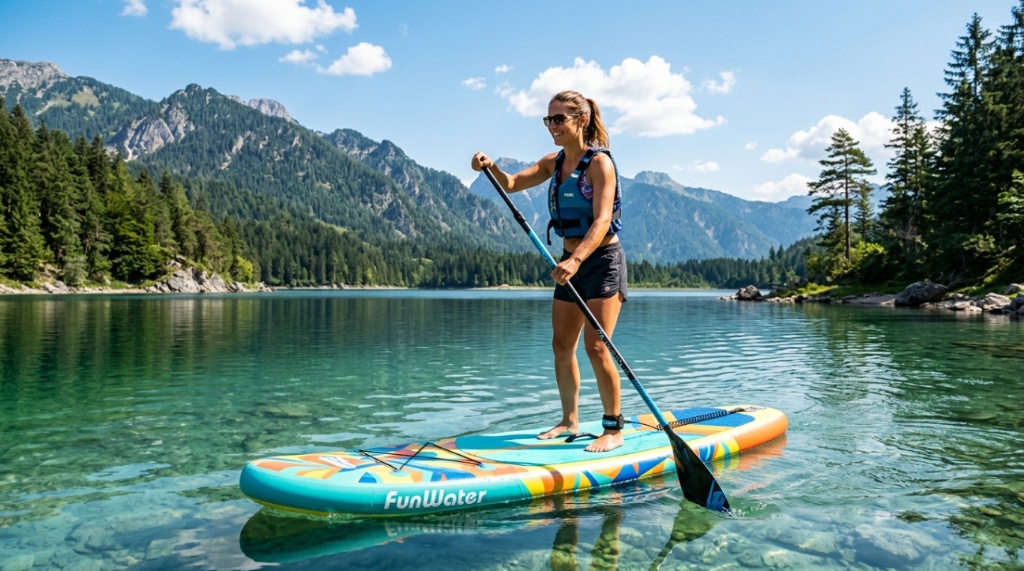
The FunWater board is not a universal fit. There are specific user profiles where this board will disappoint. We need to be clear about the limitations so you don’t purchase the wrong item.
Large Riders and Heavy Loads
If you weigh over 200 pounds or plan to bring a cooler, a large dog, or a child on the nose, this board will sit low in the water. The large volume of the board (up to 260 liters) should technically support the weight, but the rigidity issue becomes apparent. When the board flexes under heavy weight, the nose bends upward, and the tail drags. This creates an unstable platform that is difficult to balance when turning around to grab a drink.
Performance Paddlers
If you are looking for speed, yoga stability for paddleboarding, or surf ability, this is the wrong board. Yoga practitioners will find the 6-inch thickness makes it sit too high off the water, making balance more difficult than on a 5-inch thick board that sits lower and feels more “planted.” Surfers will find the lack of rocker (the curve of the nose) causes the board to pearl (nose dive) when attempting to catch a wave.
Maintenance and Longevity Tips
To get the most value out of your FunWater, you must treat it with care. Improper storage is the primary killer of inflatable boards, not punctures.
- Deflate and Roll: Always deflate the board completely before rolling it up. Do not fold it in half; roll it tightly from the nose to the tail to avoid creasing the material at the folds.
- Rinse Salt Water: After saltwater use, rinse the board and the paddle with fresh water. Salt crystals can corrode the fin box screws and weaken the PVC (Polyvinyl Chloride) glue seams over time.
- Heat Exposure: Never leave the board inflated inside a hot car. The air inside expands, increasing the PSI beyond safe limits, which can cause the seams to separate or the material to stretch permanently.
- Valve Check: Periodically check the inflation valve. A tiny grain of sand trapped in the valve can cause a slow leak. Lubricate the rubber o-ring with a touch of silicone grease to maintain an airtight seal.
Frequently Asked Questions
Is the FunWater paddle board good for beginners?
Yes, it is suitable for beginners who are paddling on calm, flat water. The wide base makes it easy to stand up on initially. However, beginners should avoid using it in windy or choppy conditions, as the thick profile makes the board difficult to control and can be frustrating for someone still learning to balance.
Can the FunWater SUP handle ocean waves?
No, it is not designed for surf. The flat rocker and planing hull make it prone to nose-diving in waves. It is best used on lakes, rivers, and protected bays. If you want to paddle in the surf, you would need a specialized, shorter board with more nose rocker.
How long does it take to inflate the FunWater board?
Using the included hand pump, expect a 15-minute session to reach the optimum 15 PSI. Many users become fatigued before reaching full pressure, leading to an under-inflated board. Using an aftermarket electric pump or a high-volume dual-action hand pump is highly recommended to make the process faster and more efficient.
Does the board come with a warranty?
FunWater generally offers a 1-year warranty covering manufacturing defects like seam separation and valve failures. This warranty does not cover punctures or damage caused by misuse, such as over-inflation or dragging the board on concrete. Warranty claims are handled via email through their support team.
Is the FunWater paddle board suitable for yoga?
While it is possible, it is not ideal. The board is quite thick, raising your center of gravity higher above the water. This makes balance poses more challenging than on thinner, wider boards specifically designed for yoga. If yoga is your primary goal, look for a board that is 33″ wide and 5″ thick for better stability.
Conclusion
The FunWater Stand Up Paddle Board is a great option for the right person. If you are a beginner paddler on a budget using it a handful of times a year on calm rivers or lakes, it serves its purpose well. It is forgiving, stable, and comes with everything you need to get on the water. However, if you see paddling as a serious fitness activity, plan on touring long distances, or frequently battle windy conditions, the FunWater will quickly feel like a limitation rather than a tool. We recommend buying it if you are testing the waters of the sport; just be prepared to upgrade to a stiffer, higher-performance board if you find yourself catching the paddling bug.



