

A recovery rope is a heavy-duty rope designed to pull a stuck 4×4 vehicle out of mud, sand, snow, or uneven terrain using controlled force and rated load capacity.
Your 4×4 is built for rough terrain. But even the most capable off-road vehicle can get stuck. Deep mud. Soft sand. Steep rock ledges. It happens fast.
The real problem? Many drivers use the wrong recovery gear. They grab a basic tow rope, attach it, and hope for the best. That’s when things go wrong—snapped lines, damaged bumpers, broken recovery points, and serious injuries.
According to multiple off-road safety reports, improper recovery equipment is one of the leading causes of recovery-related accidents. In kinetic recovery scenarios, a failed strap or rope can release stored energy with dangerous force.
This is why choosing the right recovery rope is not optional. It’s a safety decision. And it directly affects your vehicle, your equipment, and the people standing nearby.
In this guide, we break down tow rope vs kinetic rope, provide a clear recovery strap comparison, and explain how to choose the correct option based on weight, terrain, and recovery method.
What Is the Difference Between Tow Rope vs Kinetic Rope?
Short Answer: A tow rope is designed for steady pulling on stable surfaces, while a kinetic rope stretches and stores energy to help extract stuck vehicles with momentum.
Why This Difference Matters
Many off-roaders confuse these tools. But they function differently.
| Feature | Tow Rope | Kinetic Rope |
|---|---|---|
| Elasticity | Minimal stretch | 20%–30% stretch |
| Best For | Towing on roads | Vehicle recovery off-road |
| Energy Storage | No | Yes |
| Shock Absorption | Low | High |
How a Tow Rope Works
A tow rope provides constant tension. It’s suitable for moving a disabled vehicle on flat surfaces. There is no elasticity to assist extraction.
Using a tow rope for deep mud recovery often leads to jerking. That shock travels directly into recovery points and chassis components.
How a Kinetic Rope Works
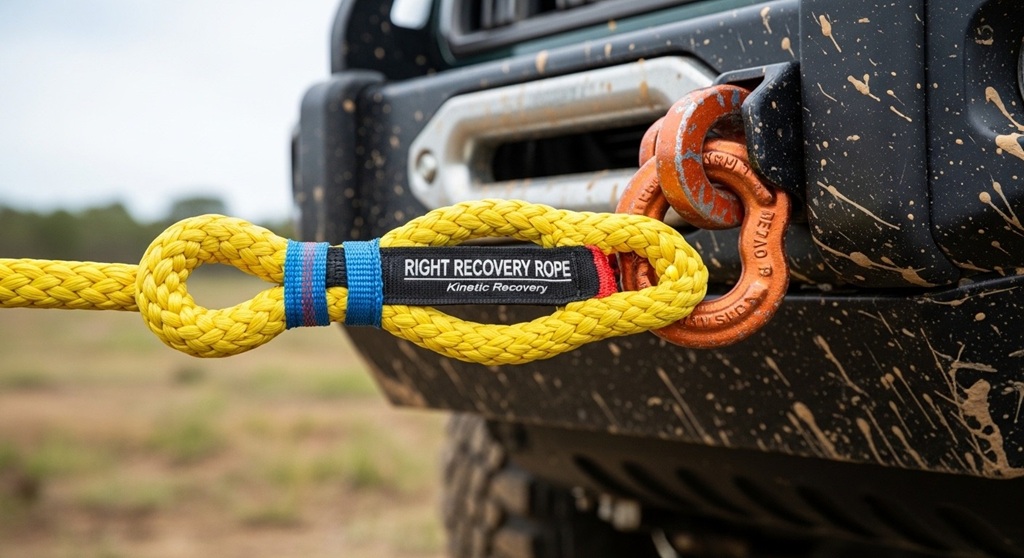
A kinetic rope stretches under load. When the pulling vehicle accelerates gently, the rope stores kinetic energy. As it contracts, it transfers that energy smoothly to the stuck vehicle.
This reduces shock load. It increases extraction success. And it lowers risk of hardware failure.
If your vehicle is deeply bogged in sand or mud, a kinetic rope is typically the safer and more effective option.
How Does Recovery Strap Comparison Help You Choose?
Short Answer: Recovery straps, tow straps, and kinetic ropes differ in stretch, construction, and purpose. Understanding these differences prevents misuse.
Recovery Strap vs Tow Strap vs Kinetic Rope
| Tool | Stretch | Use Case | Material |
|---|---|---|---|
| Recovery Strap | Low to moderate | Vehicle recovery | Polyester/Nylon |
| Tow Strap | Minimal | Flat towing | Polyester |
| Kinetic Rope | High (20–30%) | Snatch recovery | Double-braided nylon |
Key Insight
A recovery strap comparison shows that nylon-based straps allow some elasticity, but not at the same level as kinetic ropes. Polyester straps have lower stretch and are more suitable for controlled towing.
Using the wrong strap in a snatch recovery increases shock loads. That can exceed the rated working load limit (WLL) of shackles and recovery points.
What Strength Rating Should Your Recovery Rope Have?
Short Answer: Choose a recovery rope rated at 2–3 times your vehicle’s gross vehicle weight (GVW).
Example:
- Vehicle weight: 2,500 kg (5,500 lbs)
- Recommended rope rating: 11,000–16,500 lbs minimum
Why 2–3 times? Because recovery force is not equal to vehicle weight. Mud suction, incline, and resistance increase required load.
Case study data from off-road recovery testing shows that extraction forces can exceed 2x vehicle weight in deep mud conditions.
Choosing a rope under-rated for your vehicle risks catastrophic failure.
Which Material Is Best for Recovery Ropes?
Short Answer: Double-braided nylon is the preferred material for kinetic recovery ropes due to elasticity and strength.
Nylon offers:
- High elongation (energy absorption)
- Strong tensile strength
- Shock load reduction
Polyester offers:
- Lower stretch
- Better UV resistance
- Suitable for tow straps
When comparing rope construction, the outer sheath protects the core fibers from abrasion. This matters in rocky environments.
If you are exploring rope applications beyond vehicle recovery, you can review material breakdowns here:
tow rope vs kinetic rope.
What Length and Diameter Should You Choose?
Short Answer: Most 4×4 recoveries require ropes between 20–30 feet long and 7/8 to 1 1/4 inch in diameter.
Length Guidelines
- 20 ft: Controlled recoveries in tight trails
- 30 ft: Standard off-road recovery
- Longer than 30 ft: Rarely needed
Diameter Guidelines
Diameter affects breaking strength. Thicker ropes support heavier vehicles.
| Vehicle Type | Recommended Diameter |
|---|---|
| Mid-size SUV | 7/8 inch |
| Full-size 4×4 | 1 inch |
| Heavy-duty truck | 1 1/4 inch |
Always match rope diameter to weight class.
How Do You Perform a Safe Recovery?
Short Answer: Use rated recovery points, avoid tow balls, maintain distance, and use dampeners.
Step-by-Step Safety Process
- Inspect rope for cuts or frays.
- Attach only to rated recovery points.
- Never attach to a tow ball.
- Clear the recovery zone.
- Use a recovery damper blanket.
- Communicate between drivers.
- Apply smooth acceleration.
Improper attachment is a common failure point. Tow balls have sheared off during recovery and caused severe injury.
Safety is not optional. Recovery gear stores energy. Respect that energy.
When Should You Avoid Using a Kinetic Rope?
Short Answer: Avoid kinetic ropes when there are weak recovery points or uncontrolled environments.
Situations to avoid:
- Unknown anchor strength
- Metal fatigue in recovery hooks
- Close bystanders
- Extreme angles of pull
In such cases, a winch may provide better control.
How Does Terrain Influence Rope Choice?
Short Answer: Soft terrain favors kinetic ropes, while firm terrain may allow controlled tow straps.
Terrain Guide
- Sand: Kinetic rope recommended
- Deep mud: Kinetic rope preferred
- Snow: Kinetic rope effective
- Rock trails: Controlled winch or strap
Momentum-based recovery works best where suction or rolling resistance is high.
Conclusion: What Is the Right Recovery Rope for You?
Choosing the right recovery rope is not complicated. But it requires understanding.
If you are towing on pavement, a tow rope works. If you are extracting a stuck 4×4 from mud or sand, a kinetic rope is the better tool.
Match the strength rating to 2–3 times your vehicle weight. Choose nylon for elasticity. Select proper length and diameter. Use rated recovery points. Follow safety steps every time.
Recovery gear is an investment in safety. Make informed decisions before your next trail run.
Ready to upgrade your recovery setup? Review your current gear. Check load ratings. Replace worn straps. And ensure your 4×4 is prepared before your next off-road challenge.
Frequently Asked Questions (FAQ)
1. Is a kinetic rope better than a tow strap?
Yes for off-road recovery. Kinetic ropes stretch and reduce shock loads, making them safer for stuck vehicle extraction.
2. Can I use a tow rope for mud recovery?
It is not recommended. Tow ropes lack elasticity and increase stress on recovery points.
3. How often should I replace a recovery rope?
Replace immediately if you see fraying, cuts, glazing, or stiffness. Inspect after every recovery.
4. What is the ideal recovery rope length?
20–30 feet is standard for most 4×4 recovery scenarios.
5. Why should I avoid attaching to a tow ball?
Tow balls are not rated for dynamic recovery loads and can shear off under force.
6. Are synthetic ropes stronger than steel cables?
Modern synthetic ropes offer high strength-to-weight ratios and safer failure characteristics compared to steel winch cables.
7. Do I need a damper blanket?
Yes. A damper reduces recoil energy if the rope fails under load.
Related Topic: How to Pick Durable Luggage for Frequent Travelers
Read Next: How to Train Your Dog to Walk Calmly Using a No-Pull Harness



